Beyond Recovery: The Role of Data, Prevention & Decision-Making in Collections
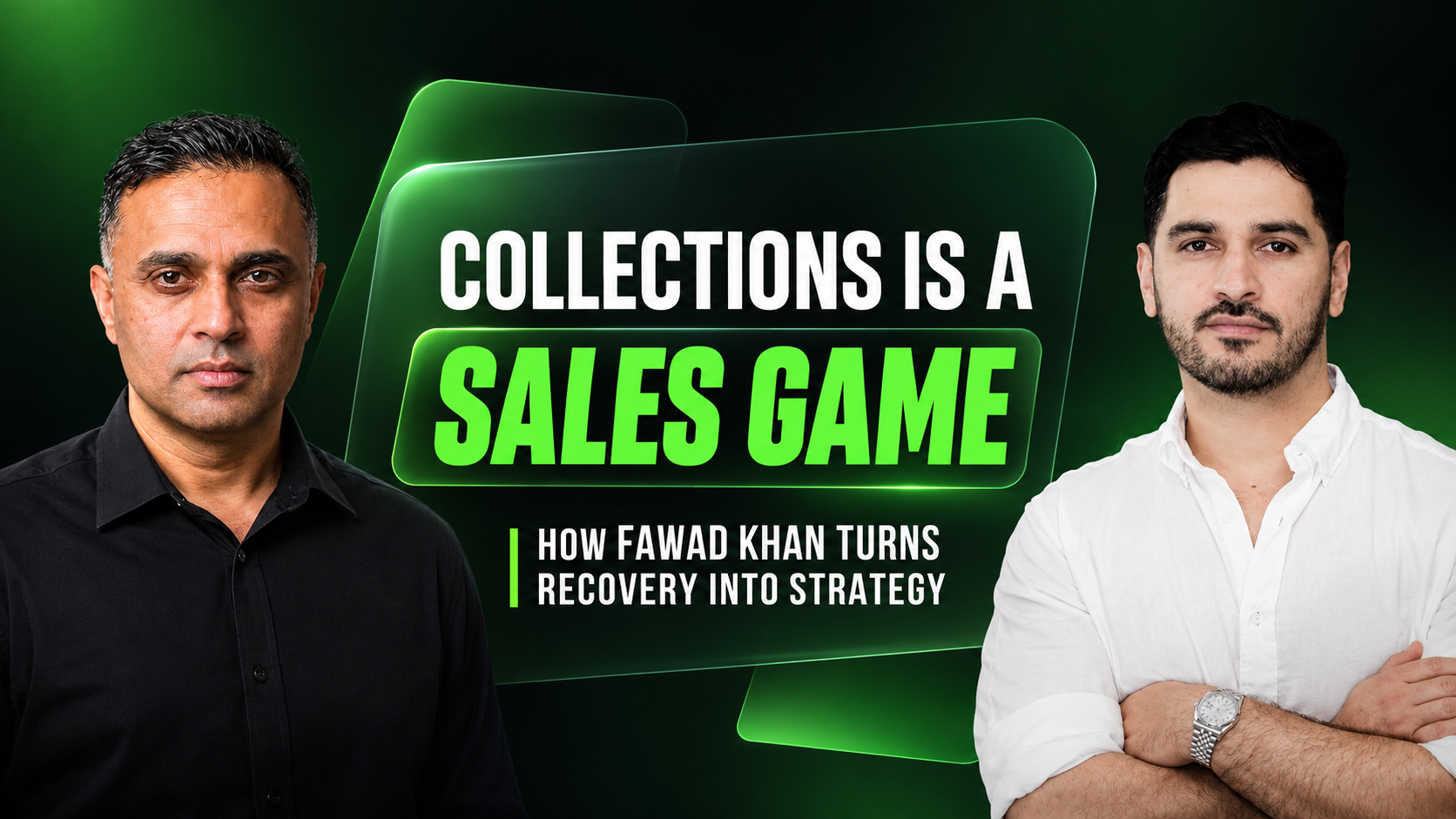
Collections Is a Sales Role:
Fawad Khan on
Recovery Strategy
Fawad Khan, Head of Collections at StorFund, on why collections is a sales role, why every default is a lesson for the front end, and why the future of the function comes down to one word: decisions.
The collections industry is being reshaped from both ends. Fintech lenders are using real-time data to decide who to lend to and how much, while collections teams face tougher regulation every year and a wave of AI tools promising to transform how portfolios are managed.
Fawad Khan is unusually well placed to speak to both sides of that shift. His career has taken him from credit decisions at the point of sale to running collections across multiple jurisdictions, with roles at Crowd2Fund, Starling Bank and now StorFund, where he heads collections for a business that advances marketplace payouts to e-commerce sellers. In this exclusive interview for TalkinDebts.org, Fawad explains how collections data should sharpen underwriting, how to manage collections across many regulatory regimes, where AI genuinely helps today, and why he believes every collector is, at heart, a salesperson.
Collections is a sales role. The product I’m selling is a recovery plan. You either buy this recovery plan or, unfortunately, you’re going to have to buy the enforcement plan.— Fawad Khan, Head of Collections, StorFund

About the Expert
Fawad Khan
Head of Collections — StorFund
- 📍 UK, Europe & multiple international jurisdictions
- 💼 10+ years in Collections, Recovery, Credit & Risk
- 🏦 Experience across Fintech, SME Lending & Banking, including Crowd2Fund, Starling Bank and StorFund
- 🎯 Specialist in multi-jurisdiction collections, data-led risk mitigation & feeding collections insight into underwriting
With a decade of experience across credit risk and collections, Fawad has built collections functions from the ground up in fintech, managed consumer collections in banking, and now leads cross-border collections at StorFund. He sees collections not as a back-office function, but as the radar that guides an entire lending business.
From Credit Risk to Collections: A Fintech-First Career
You started in credit risk and moved into collections, which few people do. What has kept you going, and how does collections differ across the environments you’ve worked in?
My first exposure to credit risk actually came before any of these companies, while I was at university working at Carphone Warehouse. We were selling phones and other technology on credit, and instead of monetary collateral, the collateral was the item itself. Your credit score determined how much could be extended to you, but it was also up to the customer to work out what they could genuinely afford. That dynamic between data and affordability fascinated me.
When it came to choosing a path, I deliberately chose fintech over traditional banking. I strongly believe fintech is the future: using technology to tackle archaic financial systems, models and products. I started at Crowd2Fund with zero experience in collections and had to build up from there. That foundation, followed by banking and other fintech roles, has shaped how I see the whole credit lifecycle.
I decided to take the route of going into fintech instead of traditional banking, because using technology to tackle archaic financial systems is exactly why I think fintech is the answer.
Collections as the Radar for Underwriting
Fintechs face real acquisition pressure. Is the collections problem usually created at the underwriting stage, and how should collections experience inform credit decisions?
A lot of people assume collections is just a back-office job that stays isolated. I wholeheartedly disagree. Everything that lands in collections is a learning curve: why did it reach this point? All of that data should be fed back to the front end. I see the front end as a radar, and you are constantly honing it as you navigate the credit risk space. The more jurisdictions, products and sellers you work with, the more finely that radar needs to be tuned.
Your sales team is your first line of defence. They are the ones out finding customers. If I learn from collections which sectors and marketplaces have led to defaults, and where we have recovered successfully, I can stop the sales team shooting in the dark and turn them into trained snipers who know exactly where the strongest, most recoverable business sits.
That naturally strengthens underwriting. And alongside underwriting, you need the right securities in place. When you work across multiple jurisdictions, your securities and your underwriting both have to be watertight.
Instead of your sales team shooting in the dark, use collections data to train them into snipers who know exactly which marketplaces deliver the highest recovery.
Managing Collections Across Multiple Jurisdictions
Every market has its own regulatory and compliance requirements, and they get tougher each year. How do you run collections across so many different markets?
First, you standardise your approach. Once the process is standardised, you can localise it, adapting the plays to each jurisdiction. You must understand the regulations in every market, and just as importantly, the securities you are taking within each legal framework.
We have excellent legal teams across the jurisdictions we cover, and keeping a very good line of communication with them means we are constantly up to date with the latest developments and local plays. Having a strong network is quintessential. I think that is the key.
Prioritisation follows the same discipline. Before an account ever reaches collections, we put heavy focus on risk mitigation, using data to identify the grey areas: is this likely to fall into collections, or can we recover it early? When cases cluster in a segment, we ask why. Is it macroeconomic, the product itself, or the clientele and what they are selling? Once we understand cause and effect, we know where to assign our resources.
Standardise your process first, then localise it for each jurisdiction, and build a strong network of local legal expertise to keep you ahead.
AI in Collections: A Brilliant Tool, Used With Care
AI is now everywhere in collections, from contact strategy to portfolio analysis to agentic voice bots. How is it shaping your organisation, and where do you see it going?
AI is the buzzword everyone is using, whether you’re speaking to investors, your own team or the wider industry. My personal view is that it’s a tool, and a brilliant one if you know how to use it. It’s like a hammer: you can use it for anything, but if you really know how to use it, you get the best out of it.
At StorFund we work across multiple jurisdictions, and a very simple example is language. I’m not fluent in every European language, but technology is. Using AI to sift through large volumes of data in different languages, and to remove a lot of that manual labour, is a brilliant use case.
AI agents handling very large volumes of customer conversations could definitely happen in the future, and speaking to customers in their own language through an agent would be powerful. But I don’t believe the technology is there yet. There is a real danger of people jailbreaking AI agents to expose vulnerabilities, and that safety mechanism still needs work.
AI is a tool, and a brilliant one if you know how to use it. But AI agents dealing with customers at scale still need safety mechanisms that aren’t there yet.
Redesigning Collections From Scratch: Why Collections Is a Sales Role
If you were redesigning a collections operation from scratch today, what would you automate first?
Everything that is manual. Automate it, automate it, automate it, and maximise efficiency. Then focus your people on what really matters: deal making and negotiation. When people ask whether AI will take their job, I strongly believe that if you are a decision maker in your role, it won’t be taken any time soon.
People who know me have heard me say this many times: collections is a sales role. When they ask how, I tell them the product I’m selling is a recovery plan. You either buy the recovery plan or, unfortunately, you buy the enforcement plan. Either way, you’re buying one of my products.
That mindset applies differently to consumers and businesses. In consumer collections you are dealing with real people, sometimes vulnerable, sometimes in truly heartbreaking situations, within a tight regulatory framework, and the job is to find a solution that genuinely helps someone who is trying their best. In business collections, the exceptional collector truly understands how the business operates and what makes it tick. Only then can you build the right recovery plan and sell it.
If you understand how a business operates and how it ticks, you can formulate the right recovery plan and sell it to them.
Quick-Fire Round: Fawad’s Take on Collections
In a rapid-fire round, Fawad gave his direct preferences on the debates shaping the industry today:
| Question | Fawad’s Answer |
|---|---|
| Underwriting or Collections? | Underwriting |
| Prevention or Recovery? | Prevention |
| Early Intervention or Late-Stage Collections? | Early Intervention |
| Cash Flow or Profitability? | Cash Flow |
| Growth or Risk Control? | Risk Control |
| Payment Plan or Settlement? | Settlement — “I like liquidity” |
| Data or Experience? | “Experience is data — but data” |
| Recovery Rate or Cure Rate? | Cure Rate |
| Human Collectors or AI? | Human collectors, now and always |
| Traditional Bank or Fintech? | Fintech all the way |
| Automation or Personal Management? | Automation |
| One Skill Every Collector Must Have? | The ability to sell |
| One KPI You Should Never Ignore? | Cure Rate |
| Strategy or Execution? | Strategy |
| Startup or Established Business? | Startup |
| The Future of Collections in One Word? | Decisions |
Video Interview Summary — Key Themes Covered
In the full video interview, Fawad Khan covers the following themes in depth. Watch on the TalkinDebts YouTube channel for the complete conversation:
- ‣ His path from point-of-sale credit at Carphone Warehouse into fintech, and building collections expertise from zero at Crowd2Fund.
- ‣ Why collections is not a back-office function, and how collections data should hone the “radar” that guides sales and underwriting.
- ‣ How to run collections across multiple jurisdictions by standardising first, localising second, and leaning on strong local legal networks.
- ‣ Using data and risk mitigation to spot accounts in the grey area before they reach collections, and understanding the cause behind each cluster of cases.
- ‣ Choosing KPIs by goal: roll rates for internal efficiency, cure rates, and time to resolution.
- ‣ Where AI helps today, from multilingual data to removing manual work, and why AI agents are not yet ready for customer conversations at scale.
- ‣ The real differences between consumer and business collections.
- ‣ StorFund’s model of advancing marketplace payouts to e-commerce sellers, underwritten daily using live data.
Key Takeaways
- ✔ Credit risk experience gives collections leaders an end-to-end view: every default is a lesson that should flow back to the front end.
- ✔ Collections data can turn a sales team from “shooting in the dark” into trained snipers targeting the most recoverable segments.
- ✔ Multi-jurisdiction collections works best with a standardised core process, localised per market and backed by strong local legal partners.
- ✔ KPIs should follow the goal; cure rate is the one Fawad says you should never ignore.
- ✔ AI is a powerful tool for removing manual work and bridging language barriers, but customer-facing AI agents still need stronger safeguards.
- ✔ Collections is a sales role: the collector’s product is a recovery plan, and the alternative is enforcement.
- ✔ Consumer collections demands care for vulnerable people under strict regulation; business collections demands a deep understanding of how the business works.
Future Outlook
Fawad Khan’s perspective points to a future where collections is driven by data and decisions rather than volume and pressure. Technology will strip out manual work, real-time data will make underwriting sharper, and AI will help teams operate across languages and borders. But the decisive moments, negotiating a recovery plan and understanding a customer or a business, will remain human.
The biggest shift may be in how collections is positioned. No longer an isolated back office, it becomes the intelligence engine for the whole lending business, telling sales where to look, underwriting what to watch, and leadership where to invest resources.
For the industry, the message is clear. The future is not about chasing harder. It is about learning faster, deciding better, and selling recovery as a genuine solution.
The future of collections, in Fawad’s own word: decisions.
Disclaimer: The views expressed in this interview are the personal professional views of Fawad Khan and do not necessarily represent those of his employer.