The Human Side of AI: Transforming Collections and Receivables Management
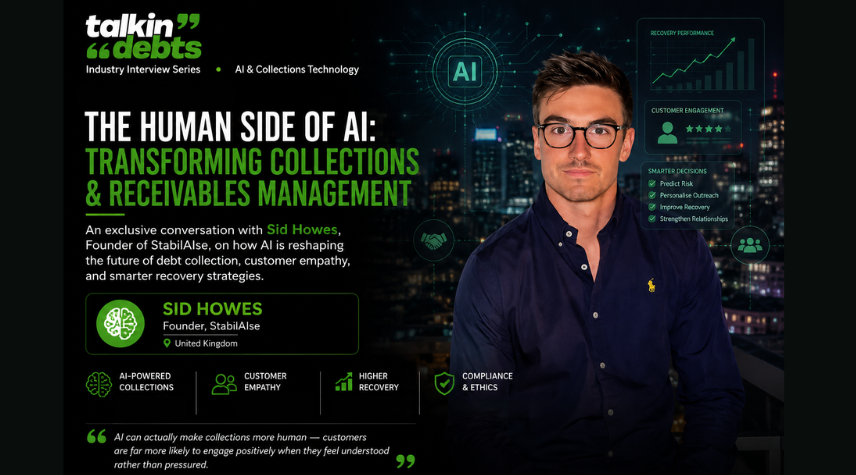
An exclusive conversation with Sid Howes, Founder of StabilAIse, on how AI is reshaping debt collection—making it smarter, more predictive, and more empathetic than ever before.
For decades, the collections industry has operated on a familiar formula: generic outreach, manual processes, and a transactional mindset that often put recovery rates above customer relationships. But that formula is under pressure. A new generation of AI-powered platforms is challenging the assumption that efficiency and empathy are mutually exclusive—and Sid Howes is at the forefront of that shift.
As Founder of StabilAIse, an AI-driven collections and receivables platform, Sid has spent his career bridging the worlds of fintech, SaaS, and AI automation to build smarter, more human-centred approaches to debt management. In this exclusive interview for TalkinDebts.org, he shares what inspired StabilAIse, how AI is fundamentally changing receivables management, and what the collections landscape will look like in five years’ time.
AI can actually make collections more human — customers are far more likely to engage positively when they feel understood rather than pressured.

About the Expert
Sid Howes
Founder — StabilAIse
- 🤖 AI-Powered Collections & Receivables Platform
- 💼 Expert in SaaS, Fintech, Collections Technology & AI Automation
- 🎯 Focused on intelligent decision-making & workflow automation
LinkedIn Profile: Sid Howes
Sid founded StabilAIse to help organisations modernise collections through intelligent decision-making, workflow automation, and better customer engagement—moving the industry beyond fragmented systems and one-size-fits-all strategies.
The Inspiration Behind StabilAIse
What inspired you to build an AI-driven collections and receivables platform, and what gap in the traditional collections ecosystem were you trying to solve?
The inspiration behind StabilAIse came from seeing how many collections teams still rely on fragmented systems, manual processes, and generic communication strategies. Businesses have enormous amounts of customer data available—but very little of it is actually used effectively.
The opportunity was to build a platform that uses AI to help organisations make smarter decisions: improving recoveries while simultaneously creating a better customer experience. Collections had long been a function that operated in silos, reactive rather than predictive, and largely unchanged despite the digital transformation happening across every other part of financial services.
StabilAIse was built to change that: to bring intelligent, data-driven decision-making to the collections lifecycle from the earliest point of risk identification through to resolution.
How AI Is Fundamentally Changing Collections
Many organisations still rely on traditional collections methods and legacy systems. From your perspective, how is AI fundamentally changing the way receivables and debt collection are managed today?
AI is helping organisations move away from one-size-fits-all collections strategies and towards more personalised engagement. Legacy approaches treat every customer the same—the same letter, the same call cadence, the same escalation path—regardless of individual circumstances or behaviours.
What AI enables is the ability to analyse customer behaviour, payment history, and communication preferences to identify the best next action for each individual account. The result is that teams can work more efficiently while genuinely improving both customer outcomes and recovery performance—not as a trade-off, but together.
AI enables organisations to identify the best next action for each individual account—efficiency and better customer outcomes, not as a trade-off, but together.
Balancing Recovery Outcomes With Customer Empathy
Collections has often been viewed as transactional or even adversarial. How do you see AI helping organisations balance stronger recovery outcomes with maintaining empathy and customer relationships?
This is perhaps the most important shift AI can enable in collections. The adversarial model is not just bad for customers—it produces worse outcomes. Customers under pressure disengage. Customers who feel understood, who are offered appropriate solutions at the right time, engage.
By understanding customer behaviour, engagement patterns, and potential signs of financial difficulty, AI allows organisations to communicate more appropriately and offer better solutions. It can detect early indicators of vulnerability and adapt the approach accordingly—something no manual process operating at scale can do consistently.
The ambition behind StabilAIse is precisely this: that technology makes collections more human, not less.
Misconceptions & Challenges in AI Adoption
What are the biggest misconceptions or challenges you encounter when organisations consider adopting AI for collections and receivables management?
The biggest misconception is that AI is there to replace people. In reality, it works best when it supports teams by automating repetitive, low-value tasks and helping them make better decisions on the cases that genuinely require human judgement. The three main challenges organisations face are:
- 📊 Data Quality Most organisations underestimate how much their results depend on the integrity and completeness of their underlying data. AI amplifies both good and poor data practices.
- 🔗 System Integration Collections functions often sit at the intersection of multiple platforms. Integration complexity can slow implementation and reduce the value of even well-designed AI tools.
- ⚖️ Transparency & Compliance Ensuring AI-driven decisions remain explainable, auditable, and compliant with consumer protection frameworks is non-negotiable—and requires deliberate design from the outset.
The biggest misconception is that AI is there to replace people. In reality, it works best when it supports teams to make better decisions.
The Future of Collections: A 3–5 Year Outlook
Looking ahead 3–5 years, what do you believe the future of collections and receivables management will look like, and what role will AI play in shaping that future?
Collections will become far more predictive, automated, and customer-focused. The shift from reactive to proactive is already underway: rather than responding when an account reaches a certain delinquency stage, organisations will be identifying risk much earlier and intervening with the right communication at the right moment.
AI will help organisations personalise engagement at scale in ways that simply are not possible with human-only teams. Many routine processes—payment reminders, hardship triage, plan adjustments—will be largely automated, freeing collections professionals to focus on complex cases that require genuine expertise and judgement.
The businesses that succeed in this environment will be those that use technology not just to improve recovery rates, but to genuinely improve the customer experience. Those two things are not in tension—they reinforce each other.
The businesses that succeed will be those that use technology not just to improve recoveries, but to create better customer experiences as well.
Key Takeaways
- ✔ Fragmented systems, manual processes, and generic strategies remain the biggest barriers to effective collections—AI directly addresses all three.
- ✔ Personalised, behaviour-driven engagement produces better recovery outcomes than one-size-fits-all approaches.
- ✔ AI makes collections more human by enabling organisations to detect vulnerability early and adapt communication accordingly.
- ✔ The biggest misconception is that AI replaces people—its real value lies in supporting better human decision-making.
- ✔ Data quality, system integration, and compliance transparency are the three critical success factors for AI adoption in collections.
- ✔ The future of collections is predictive, automated, and customer-focused—recovery performance and customer experience are complementary, not competing goals.
Future Outlook
The collections industry stands at a genuine inflection point. Organisations that continue to rely on legacy systems and generic strategies will find themselves at an increasing disadvantage—not just in recovery performance, but in customer trust and regulatory resilience.
Sid Howes and StabilAIse represent a clear direction of travel: intelligent, empathetic, and data-driven collections that serve both the creditor and the customer. As AI capabilities mature and data infrastructure improves, the gap between early adopters and laggards in this space will widen significantly.
For organisations evaluating their collections technology roadmap, the question is no longer whether to adopt AI—it is how quickly they can do so in a way that is transparent, compliant, and genuinely customer-centred.
Collections will become far more predictive, automated, and customer-focused. The businesses that succeed will use technology to create better customer experiences—not just better recovery rates.