Mapping the Invisible: How to Navigate Credit Risk and Asset Recovery in Latin America
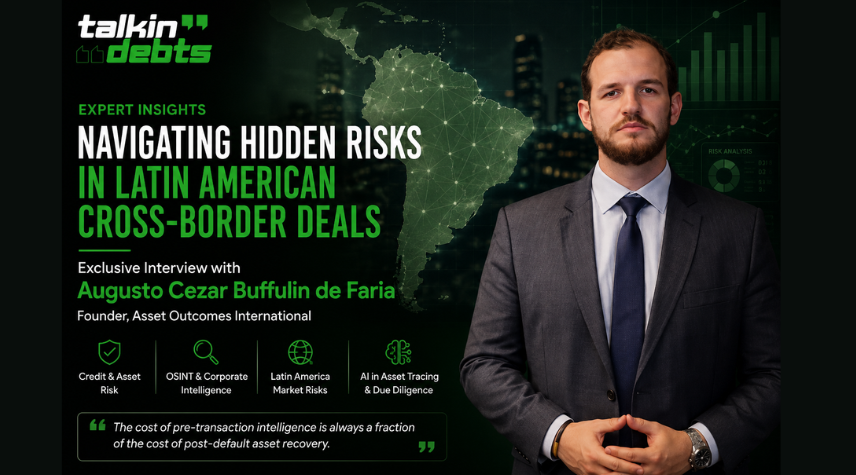
An exclusive conversation with Augusto Cezar Buffulin de Faria, Founder of Asset Outcomes International, on the hidden forces that determine whether cross-border deals succeed—or collapse.
When businesses venture into cross-border transactions in Latin America, they often discover too late that the risks were never hidden—they were simply underestimated. In a region where multi-layered holding structures, uneven audit cultures, and the gap between contractual and enforceable rights can quietly unravel even the most carefully negotiated deal, having the right intelligence before you sign is not a luxury. It is a prerequisite.
Augusto Cezar Buffulin de Faria has built his career operating precisely at that gap. As Founder of Asset Outcomes International (AOI), a São Paulo-based corporate intelligence and asset recovery firm, he works where conventional audits look past and lawyers arrive too late. In this exclusive interview for TalkinDebts.com, Augusto delivers a frank, practitioner-level guide to credit risk, OSINT-driven due diligence, the most dangerous markets in the region today, and the single most important question businesses fail to ask before closing.
The businesses that get hurt are often sophisticated players who applied a due diligence framework designed for North American or European counterparties and never recalibrated it for the structural realities of this region.

About the Expert
Augusto Cezar Buffulin de Faria
Founder — Asset Outcomes International (AOI)
- 📍 São Paulo, Brazil (Av. Brigadeiro Faria Lima)
- 🎓 LLB, Universidade Presbiteriana Mackenzie
- 📖 Postgraduate: FGV Business Law & Civil Procedure
- ⚖️ OAB Member — International Law, Civil Law, Civil Procedure & Civil Liability Commissions
- LinkedIn Profile
Augusto founded AOI to serve transactions where conventional audit and legal counsel reach their limits—complex cross-border deals involving concealed ownership structures, undisclosed liabilities, and reputational exposure invisible to standard due diligence.
The Blind Spots That Cost Businesses Most
For businesses entering complex transactions in Latin America, what are the credit and asset risks that most commonly catch them off guard?
Latin America consistently surprises foreign counterparties—not because the risks are hidden, but because they are systematically underestimated. Three blind spots stand out above all others.
The first is the opacity of beneficial ownership structures. Assets are routinely nested inside multi-layer holding arrangements spanning Panama, the British Virgin Islands, and Uruguay, making direct enforcement practically unworkable.
The second is the gap between contractual rights and enforceable rights. A perfectly drafted agreement governed by English law is meaningless if the debtor’s operational assets sit behind a Brazilian holding company subject to local insolvency law.
The third—and perhaps most pervasive—is over-reliance on self-reported financial data. In markets where audit culture is uneven and related-party transactions are endemic, credit decisions anchored to unverified balance sheets routinely lead to material exposure.
OSINT Intelligence vs. Traditional Due Diligence
How does OSINT-based intelligence differ from traditional due diligence—and why does it matter for credit and asset decisions?
Traditional due diligence is fundamentally declaratory: it relies on what a subject chooses to present—financial statements, corporate documents, reference lists. OSINT inverts that dynamic entirely. It is observational rather than declaratory, and its value lies precisely in what is not volunteered.
By mapping a counterparty’s footprint across public registries, litigation databases, procurement records, corporate gazette publications, satellite imagery, domain registration histories, and social signals, AOI constructs an independent picture of economic reality. The delta between that picture and the official narrative is where risk lives.
In practice, the most consequential findings have rarely come from formal filings—they have come from cross-referencing a beneficial owner’s political exposure in one jurisdiction against corporate registrations in two others, or from identifying undisclosed litigation predating the transaction window.
It is the difference between knowing who you are contractually exposed to and knowing what that exposure means in terms of recoverable value.
The Highest-Risk Markets in Latin America Right Now
Which markets in Latin America present the highest risk for businesses right now—and why?
Venezuela has effectively ceased to function as a rule-of-law jurisdiction for commercial purposes—but it is a known frontier. The markets that generate the most unexpected losses are those that carry institutional credibility while concealing structural fragility.
- 🇦🇷 ArgentinaA deeply problematic environment. Exchange controls, a multi-tier currency architecture, and unpredictable judicial intervention mean even secured creditors routinely face prolonged attrition.
- 🇧🇴🇳🇮 Bolivia & NicaraguaRegulatory unpredictability compounded by limited international judicial cooperation creates an increasingly hostile environment for foreign creditors.
- 🇪🇨 EcuadorRecent political turbulence has introduced new layers of counterparty risk in sectors previously considered stable within the Andean corridor.
- 🇧🇷 BrazilThe region’s largest economy. Post-reform insolvency framework favours restructuring over claim satisfaction. The scale of informal corporate networks demands forensic depth that most creditors underestimate.
AI in Corporate Intelligence: Accelerant or Threat?
How is AI changing the corporate intelligence and asset tracing space—do you see it as a threat or an opportunity for specialist firms like yours?
AI is unambiguously an accelerant, and I regard it primarily as an opportunity—but with a significant caveat. The automation of data aggregation, entity resolution, and pattern recognition has compressed timelines that previously required weeks into hours. Models that cross-reference corporate registry data against litigation records, beneficial ownership disclosures, and open-source commercial intelligence are genuinely transformative for firms operating at scale.
However, AI tools produce probabilistic outputs. In a practice where the difference between an accurate finding and a false positive can determine whether a creditor obtains or loses a multi-million-dollar enforcement order, the human interpretive layer—the judgment that contextualises raw intelligence within a specific legal and cultural framework—remains irreplaceable.
A platform that returns a clean profile on a Brazilian conglomerate because its subsidiary structures do not appear in English-language sources is not validating the counterparty: it is confirming the limits of its own dataset. For specialist firms, the strategic advantage is not access to technology, but the ability to deploy it with the jurisdictional expertise and analytical rigour that separates intelligence from information.
The risk is not that AI displaces specialists, but that it creates a false sense of comprehensiveness among buyers of off-the-shelf intelligence products.
Expert Advice: The Question That Changes Everything
What is one piece of advice you would give a business about to enter a complex cross-border transaction that has not done proper due diligence?
Map the enforcement path before you sign anything.
Most cross-border transactions in Latin America are structured with appropriate legal formalism—governing law clauses, arbitration provisions, security packages—but almost none are structured with a clear-eyed analysis of what enforcement actually looks like if the counterparty defaults.
What are the jurisdictions in which the debtor holds recoverable assets? What is the local legal mechanism for recognising your judgment or arbitral award? Which assets are likely to be shielded, pledged, or operationally untouchable by the time enforcement becomes relevant?
These are not hypothetical questions—they are the architecture of your real exposure. Businesses that commission this analysis before closing, rather than after default, are the ones that either price the risk correctly, renegotiate the structure, or walk away from deals that would have been commercially and legally catastrophic.
The cost of pre-transaction intelligence is always a fraction of the cost of post-default asset recovery.
Key Takeaways
- ✔ Beneficial ownership opacity, the contractual vs. enforceable rights gap, and unverified financial data are Latin America’s three most dangerous credit blind spots.
- ✔ OSINT builds an independent picture of economic reality—the gap between that picture and the official narrative is where risk lives.
- ✔ Argentina, Bolivia, Nicaragua, Ecuador, and Brazil each present distinct but serious structural risks for foreign creditors right now.
- ✔ AI accelerates intelligence gathering but creates a false sense of comprehensiveness without the human interpretive layer to contextualise it.
- ✔ Mapping the enforcement path before signing—not after default—is the most valuable due diligence a business can commission.
- ✔ Pre-transaction intelligence costs a fraction of what post-default asset recovery demands.
Future Outlook
As cross-border trade between Latin America and global markets deepens, the demand for specialist intelligence that bridges legal rigour, forensic depth, and local jurisdictional knowledge will only intensify. Augusto believes the firms and creditors that invest in enforcement-path architecture at the structuring stage—rather than scrambling for asset recovery after default—will define best practice in the decade ahead.
For businesses that take the region seriously, the message is clear: sophisticated legal drafting is necessary, but it is not sufficient. The real question is not whether your contract is enforceable in principle—it is whether your assets are recoverable in practice.
In my experience, the deals that go wrong are rarely surprises. They are the ones where the warning signs were visible—but nobody looked.