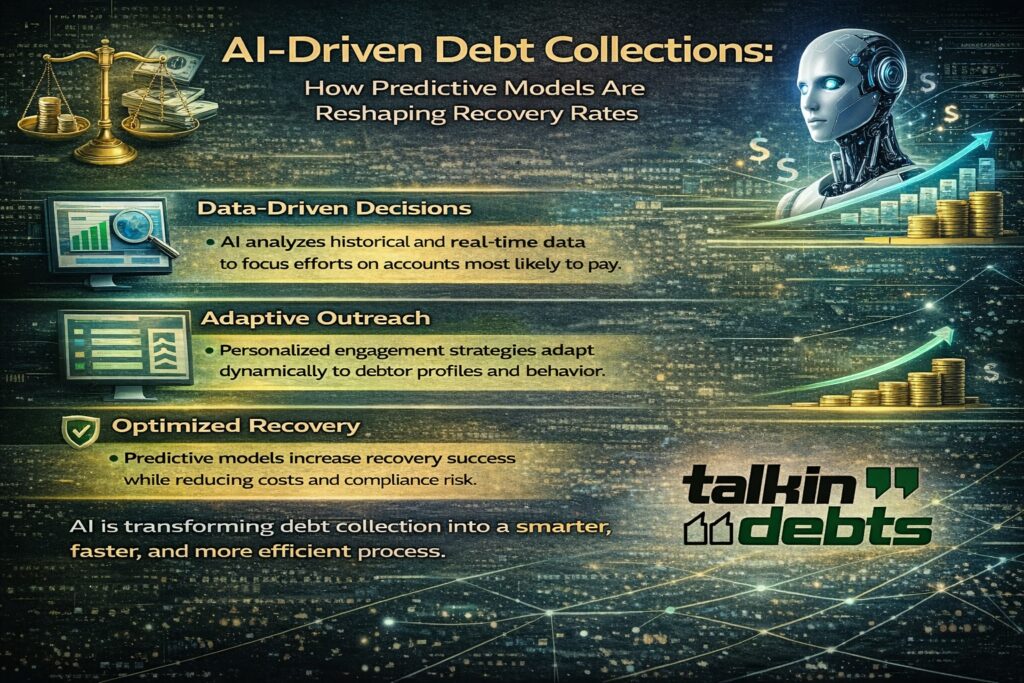
AI-Driven Debt Collections: How Predictive Models Are Reshaping Recovery Rates
Debt collection is entering a new era—one defined by intelligence rather than intensity. As financial pressure on consumers and businesses continues to rise, lenders and collection agencies are being forced to rethink how recovery strategies are designed and executed. AI-driven debt collections are no longer an emerging concept; they are becoming the operational backbone of modern recovery frameworks.
Traditional collection methods were built for scale, not precision. They relied on rigid rules, manual segmentation, and broad assumptions about debtor behaviour. In today’s environment—characterised by digital-first consumers, volatile economic conditions, and heightened regulatory scrutiny—these approaches are increasingly ineffective.
Predictive models powered by artificial intelligence are reshaping debt recovery by enabling smarter decisions, earlier interventions, and more compliant engagement. The result is a measurable improvement in recovery rates, operational efficiency, and customer outcomes.
The Limitations of Traditional Debt Collection Models
Legacy collection systems operate on static logic. Accounts are grouped by days past due, agents follow predetermined scripts, and outreach strategies are applied uniformly across diverse borrower profiles. This approach fails to account for individual behaviour, changing financial circumstances, or engagement preferences.
As portfolios grow and delinquency patterns become more complex, these limitations create inefficiencies:
- High-potential accounts are over-contacted
- Low-probability accounts consume excessive agent time
- Early warning signs are missed
- Compliance risk increases due to inconsistent execution
AI-driven debt collections address these challenges by replacing static rules with adaptive, learning-based systems.
Predictive Intelligence as the Foundation of Modern Recovery
Predictive intelligence is the core differentiator in AI-driven debt collections. Instead of reacting to missed payments, predictive models forecast behaviour before accounts deteriorate further.
By analysing historical data alongside real-time behavioural signals, these models assess not just whether an account is overdue, but how it is likely to resolve. This enables recovery strategies that are proactive rather than reactive.
Predictive intelligence enables organisations to:
- Identify accounts most likely to self-cure
- Detect early signs of financial stress
- Prioritise outreach based on resolution probability
- Select the most effective engagement strategy
This shift dramatically improves both speed and success of recovery efforts.
Advanced Scoring That Focuses on Recovery Outcomes
AI-driven scoring models go far beyond traditional credit risk assessment. They are designed specifically for debt recovery, focusing on engagement likelihood and payment intent rather than default prediction alone.
Scores are continuously updated based on:
- Payment behaviour and partial repayments
- Response patterns to previous outreach
- Channel engagement history
- Timing sensitivity and frequency tolerance
This dynamic scoring ensures that recovery strategies evolve as debtor behaviour changes. Accounts are never locked into a fixed treatment path, allowing for more flexible and effective resolution.
Intelligent Automation Without Over-Contacting
Automation is a powerful tool in debt collections, but its effectiveness depends on how intelligently it is applied. AI-driven automation ensures that digital outreach is purposeful, measured, and aligned with debtor behaviour.
Rather than increasing contact volume, predictive systems reduce unnecessary touchpoints by focusing on relevance and timing. Automated communications are deployed when they are most likely to succeed, while accounts showing resistance or vulnerability are escalated appropriately.
Intelligent automation supports:
- Timely digital reminders aligned with payment patterns
- Reduced agent dependency for early-stage collections
- Seamless escalation to human agents when required
- Consistent messaging aligned with regulatory requirements
This approach improves engagement while protecting customer relationships.
Human-Centric Agent Augmentation
AI-driven debt collections enhance human capability rather than replacing it. Agents are supported by real-time insights that help them navigate conversations with confidence and consistency.
Predictive systems provide agents with context before engagement begins, allowing them to focus on resolution rather than discovery. During interactions, AI tools offer guidance that improves decision-making without removing human judgment.
Agent augmentation typically delivers:
- Clear prioritisation of high-impact cases
- Suggested negotiation paths based on historical outcomes
- Alerts for compliance-sensitive situations
- Reduced average handling time with better results
This leads to higher productivity, lower attrition, and more predictable performance across teams.
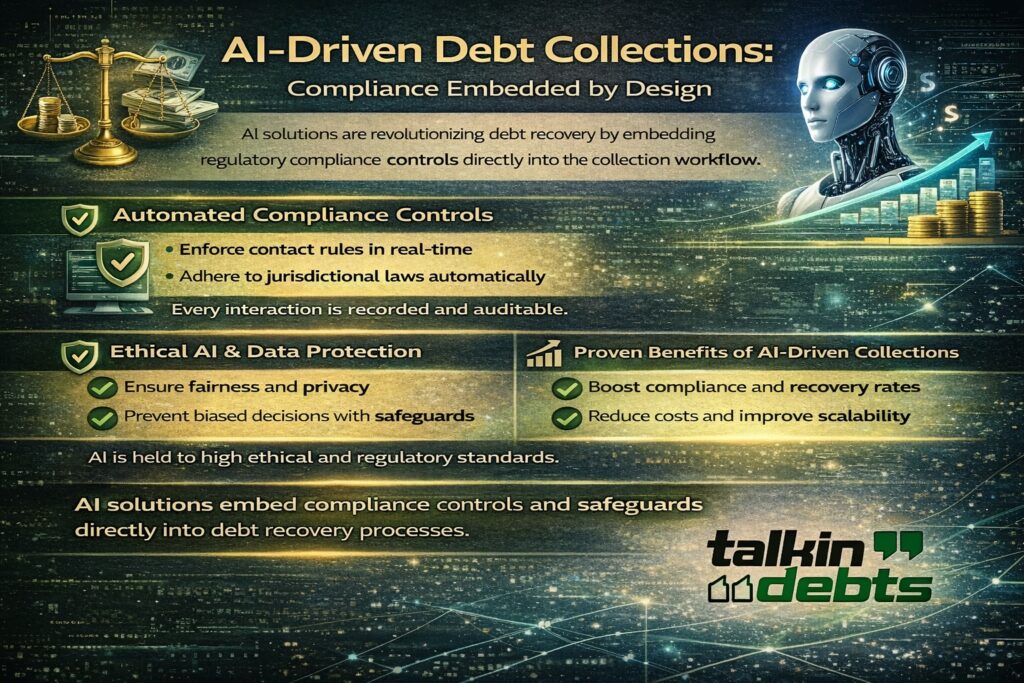
Compliance Embedded by Design
Regulatory compliance is no longer a back-office function—it is central to recovery strategy. AI-driven debt collections embed compliance controls directly into operational workflows.
Predictive platforms automatically enforce contact rules, communication windows, and jurisdiction-specific requirements. This removes reliance on manual checks and significantly reduces the risk of human error.
Every interaction is recorded and auditable, creating transparency for internal governance and external regulators. Compliance becomes proactive rather than reactive, strengthening trust and reducing legal exposure.
Ethical AI and Responsible Use of Data
As artificial intelligence becomes more influential in recovery decisions, ethical implementation is essential. Responsible AI-driven debt collections prioritise fairness, explainability, and data protection.
Advanced platforms incorporate safeguards to prevent biased outcomes and ensure that decisions can be reviewed and justified. Data usage is tightly governed, aligned with privacy regulations and customer consent frameworks.
Ethical AI is not only a regulatory requirement—it also improves engagement outcomes by fostering trust and reducing disputes.
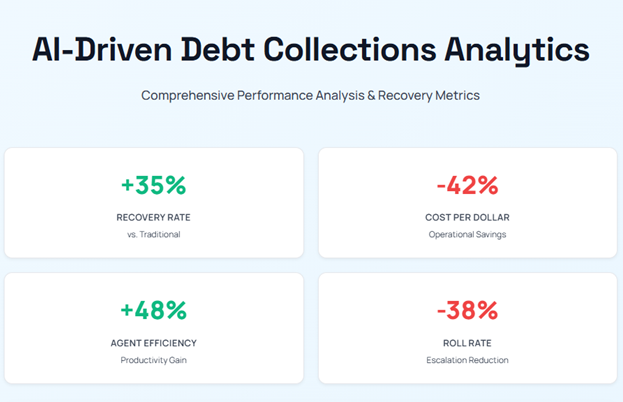
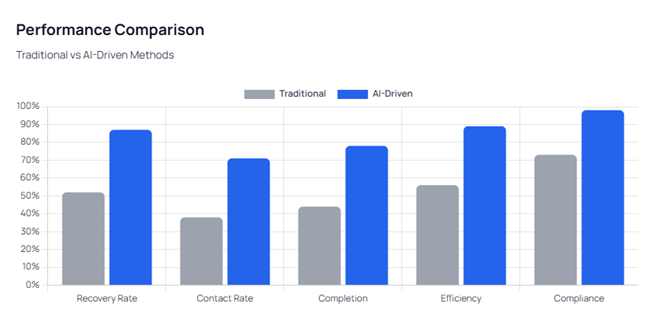
Measurable Impact on Recovery Rates and Operational Efficiency
The impact of AI-driven debt collections is not theoretical. Organisations adopting predictive recovery models consistently report strong improvements across key metrics.
Common performance gains include:
- Higher early-stage recovery and faster resolution
- Reduced roll rates into late-stage or legal collections
- Lower cost per recovered dollar
- Improved agent efficiency and utilisation
These improvements compound over time as models continue to learn, adapt, and optimise strategies based on outcomes.
Scalability Across Debt Types and Portfolios
AI-driven debt collections are highly adaptable and scalable. Predictive models can be tailored for different asset classes, customer segments, and regulatory environments without requiring structural changes to core systems.
They are now widely used across:
- Consumer lending and credit card portfolios
- Buy-now-pay-later and digital lending platforms
- Small and medium enterprise receivables
- Utilities, telecom, and subscription-based services
- Healthcare and commercial debt portfolios
This flexibility makes AI an essential capability for organisations managing complex or growing portfolios.
Strategic Advantage in a Volatile Economic Environment
Economic uncertainty has increased the importance of efficient and compliant debt recovery. Rising interest rates, cost-of-living pressures, and shifting consumer behaviour demand smarter recovery strategies.
AI-driven debt collections provide a strategic advantage by enabling early intervention, precision targeting, and consistent execution at scale. Organisations that invest in predictive intelligence are better equipped to manage risk, protect margins, and maintain customer relationships during periods of volatility.
The Future of Debt Recovery Is Predictive
Debt recovery is no longer about chasing overdue balances—it is about understanding behaviour, anticipating outcomes, and acting with precision. Predictive models, intelligent automation, and augmented agents are redefining what effective collections look like.
As regulatory expectations rise and operational margins tighten, AI-driven debt collections will become the standard rather than the exception.
Final Perspective
AI-driven debt collections represent a structural shift in how recovery is approached. Predictive models replace assumptions with intelligence, automation enables respectful and efficient engagement, and compliance becomes embedded rather than enforced after the fact.
For lenders and collection agencies seeking sustainable recovery performance in an increasingly complex environment, artificial intelligence is no longer optional. It is the foundation of modern, resilient, and high-performing debt recovery operations.