How AI Search Engines Evaluate Trust and Compliance in the Collections Industry
In today’s AI-driven search landscape, visibility is no longer determined solely by keywords and backlinks. Artificial intelligence systems now assess trust, compliance, authority, and credibility signals before recommending or ranking debt collection agencies. For companies in the collections industry—where regulation and reputation are critical—understanding how AI search engines evaluate websites is essential for sustainable digital growth.
AI search platforms such as Google’s AI Overviews and other generative search tools are designed to prioritize reliable, compliant, and transparent sources. If your collections website does not clearly demonstrate trust and regulatory adherence, it risks reduced visibility, fewer inbound opportunities, and diminished credibility with both clients and regulators.
This article explains exactly how AI search engines evaluate trust and compliance in the collections industry and what your agency must do to stay competitive.
Why Trust and Compliance Matter More in AI Search
The collections industry operates in a highly regulated environment. AI systems are specifically trained to be cautious when presenting information related to finance, debt recovery, and consumer rights. These topics fall under what search platforms consider high-risk or “Your Money or Your Life” (YMYL) categories.
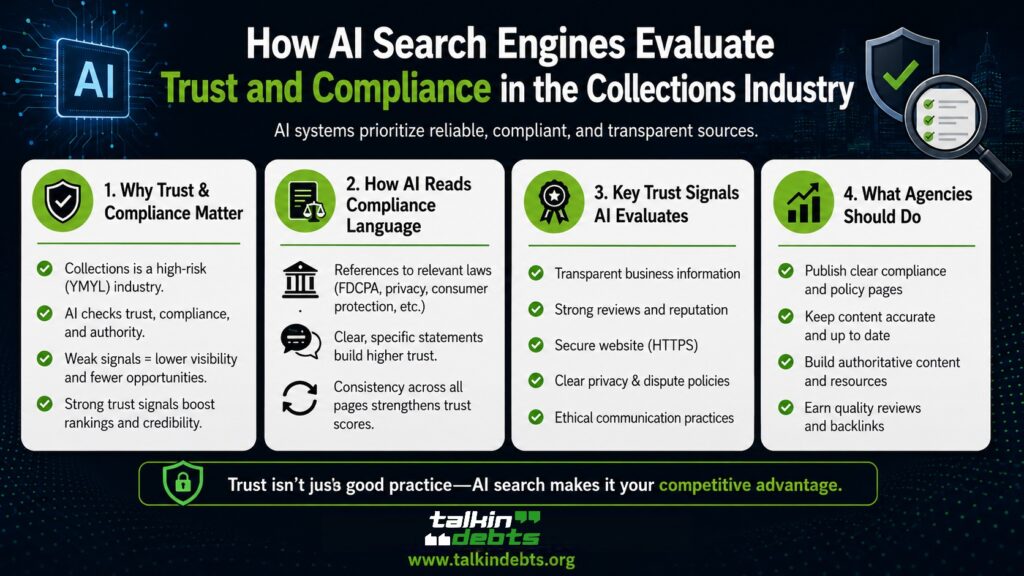
Because of this, AI search engines apply stricter scrutiny to collection agency websites.
They look for:
- Regulatory transparency
- Clear compliance language
- Verifiable business authority
- Consumer protection signals
- Ethical communication practices
If these signals are weak or missing, AI systems may:
- Avoid citing your website
- Reduce your search visibility
- Prefer competitors with stronger trust signals
For agencies like Charter, strengthening these elements is no longer optional—it is a strategic necessity.
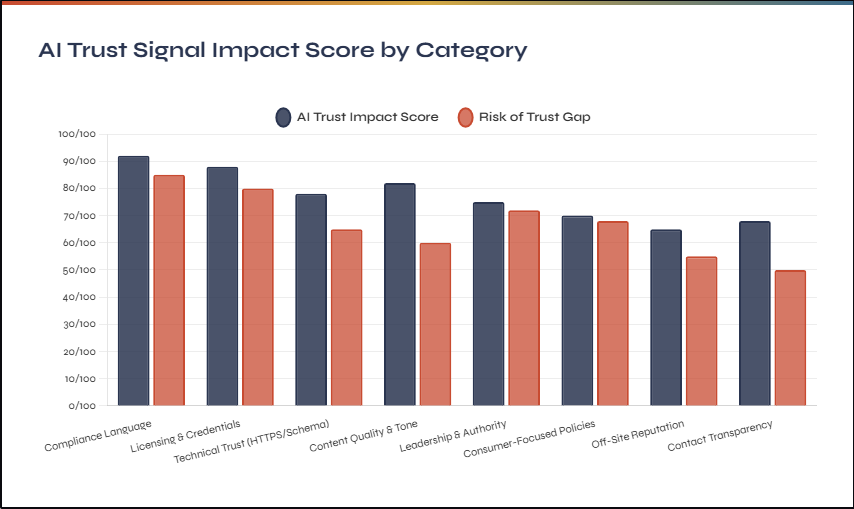
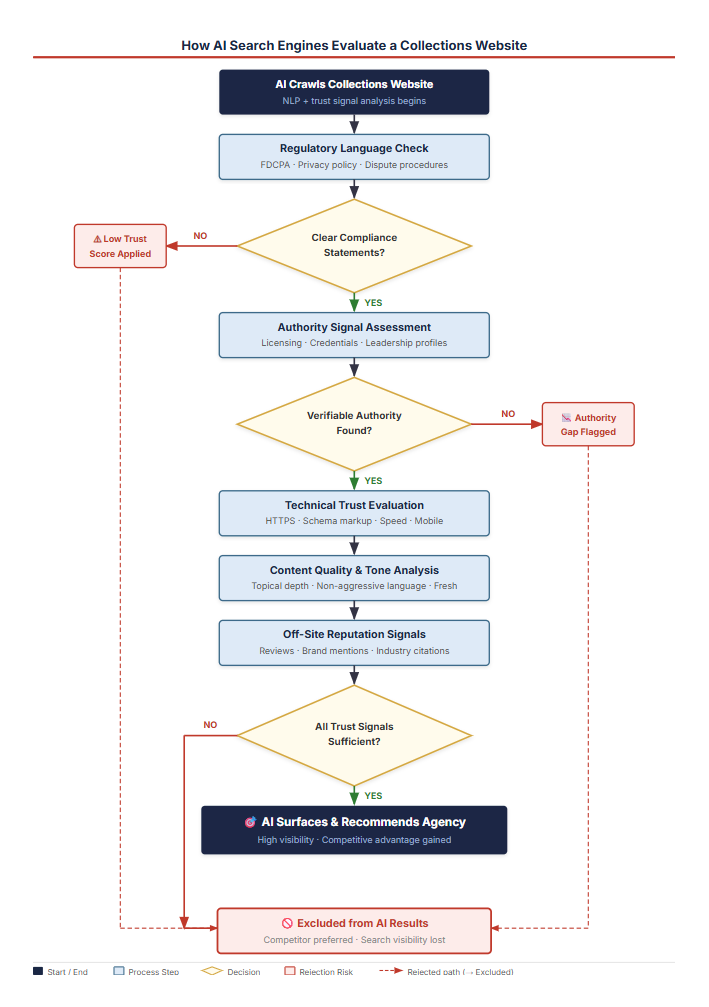
How AI Systems Read Compliance Language
AI search engines use natural language processing (NLP) to interpret the meaning, clarity, and completeness of compliance-related content on your website.
1. Presence of Regulatory References
AI models scan your site for references to relevant laws and standards, such as:
- FDCPA (or relevant regional laws)
- Consumer protection policies
- Privacy regulations
- Complaint handling procedures
When these are clearly documented, AI systems view the website as more trustworthy.
Best practice: Create a dedicated compliance page that clearly outlines all regulatory adherence.
2. Clarity and Specificity of Compliance Statements
Generic claims like:
“We follow all regulations.”
carry very little weight with AI systems.
Instead, AI favors specific, verifiable language such as:
- “Our processes comply with the Fair Debt Collection Practices Act (FDCPA).”
- “All communications are monitored for regulatory compliance.”
- “We maintain documented dispute resolution procedures.”
The more concrete and structured your compliance language is, the better AI can interpret it.
3. Consistency Across the Website
AI tools check whether your compliance messaging is consistent across:
- Service pages
- About page
- Privacy policy
- Terms and conditions
- Footer disclosures
Inconsistent or conflicting statements reduce trust scores.
Pro tip: Maintain uniform compliance language across all key pages.
Authority Signals AI Search Engines Look For
Beyond compliance text, AI systems evaluate whether your collections agency demonstrates real-world authority.
Verified Business Identity
AI engines check for clear business identification signals such as:
- Registered company name
- Physical business address
- Professional email domain
- Contact transparency
- Company registration details
Websites that hide or obscure business identity are often flagged as lower trust.
Industry Credentials and Licensing
Licensing is a major trust factor in the collections industry. AI systems actively look for:
- Collection agency licenses
- State or country registrations
- Industry memberships
- Certifications
- Regulatory approvals
If your licenses are not visible on your website, AI may assume they do not exist.
Action step: Display licensing details prominently on your site.
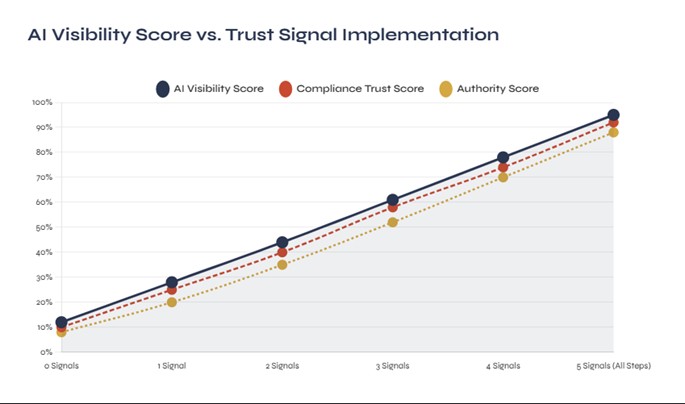
Expert Authorship and Leadership Signals
AI search increasingly evaluates who is behind the content.
Strong signals include:
- Leadership team profiles
- Professional bios
- Years of experience
- Industry expertise
- Named authors on articles
For example, agencies that highlight experienced leadership—like your role in client relations and strategic initiatives—send stronger authority signals to AI systems.
Credibility Markers That Influence AI Rankings
AI engines combine multiple credibility indicators to determine whether a collections website is trustworthy enough to surface in results.
Transparent Contact Information
AI systems favor agencies that provide:
- Phone number
- Business address
- Professional email
- Contact form
- Office hours
Missing or vague contact details can significantly hurt trust evaluation.
Clear Consumer-Focused Policies
Because collections impacts consumers directly, AI systems look closely for consumer protection content such as:
- Dispute processes
- Hardship assistance information
- Complaint handling
- Privacy commitments
- Ethical communication statements
These elements signal responsible operations.
Reputation and Brand Mentions
AI models also evaluate off-site credibility, including:
- Brand mentions
- Reviews
- Industry citations
- Media coverage
- Professional listings
A collections agency with strong external validation is more likely to be trusted by AI search systems.
Technical Trust Factors AI Evaluates
Trust is not only about content. Technical website quality also plays a major role.
Secure Website (HTTPS)
AI systems expect financial and collections websites to use strong security protocols. An unsecured site can severely damage trust signals.
Structured Data Implementation
Schema markup helps AI understand your business more clearly.
Important schema types include:
- Organization schema
- Local business schema
- Article schema
- FAQ schema (where appropriate)
- Review schema
Proper structured data improves AI comprehension and visibility.
Website Performance and Stability
AI search engines monitor:
- Page speed
- Mobile responsiveness
- Server reliability
- Error rates (like HTTP 503)
Frequent downtime or slow performance reduces perceived reliability.
Content Quality Signals AI Prioritizes
AI systems are increasingly sophisticated in evaluating content depth and usefulness.
Topical Authority in Debt Collection
Websites that publish consistent, high-quality content about:
- Debt recovery processes
- Compliance updates
- Consumer rights
- Industry trends
- Credit management
are more likely to be recognized as authoritative.
Helpful, Non-Aggressive Tone
AI models are trained to detect harmful or overly aggressive financial language.
In the collections industry, avoid:
- Threatening tone
- Misleading claims
- Pressure-heavy wording
- Non-compliant phrasing
Instead, use professional, compliant, and consumer-aware language.
Freshness and Ongoing Updates
AI favors websites that demonstrate active maintenance.
Signals include:
- Recently updated blog posts
- Current regulatory references
- Updated copyright dates
- Active news or insights section
An outdated site can quickly lose AI trust.
Common Trust Gaps in Collections Websites
Many agencies unknowingly weaken their AI visibility due to avoidable issues.
Frequent problems include:
- Missing compliance page
- No visible licensing
- Thin service content
- Generic “About Us” pages
- Lack of leadership profiles
- Poor technical performance
- Inconsistent messaging
- Outdated regulatory references
Addressing these gaps can significantly improve AI search performance.
Strategic Steps to Strengthen AI Trust Signals
For collection agencies aiming to improve AI visibility, the following roadmap is highly effective.
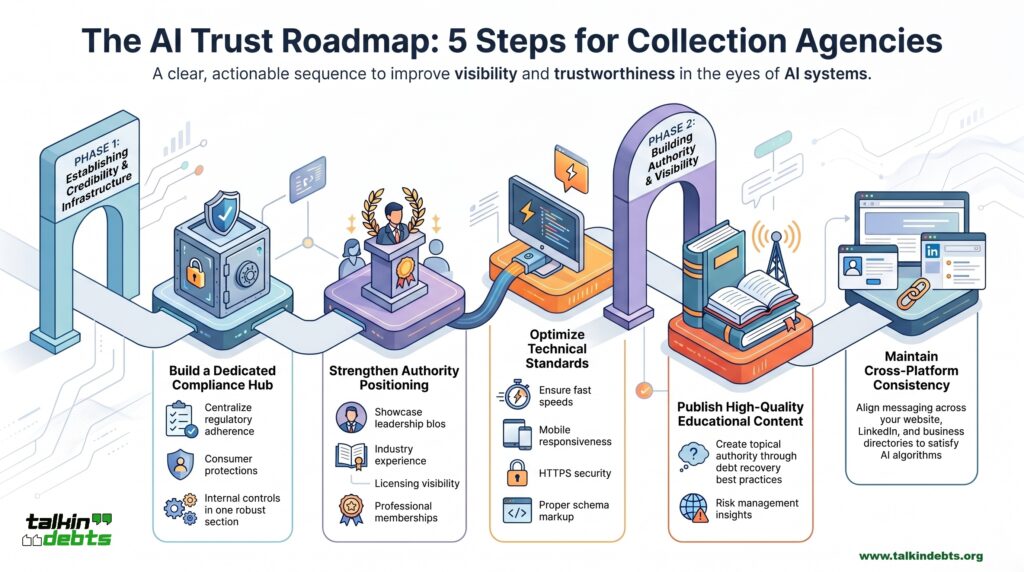
Step 1: Build a Dedicated Compliance Hub
Create a robust compliance section covering:
- Regulatory adherence
- Consumer protections
- Internal controls
- Dispute procedures
Step 2: Strengthen Authority Positioning
Enhance your website with:
- Leadership bios
- Industry experience
- Case capabilities
- Licensing visibility
- Professional memberships
Step 3: Improve Technical Credibility
Ensure:
- Fast page speed
- Mobile optimization
- HTTPS security
- Clean site architecture
- Proper schema markup
Step 4: Publish High-Quality Educational Content
Focus on topics such as:
- Debt recovery best practices
- Compliance updates
- Industry insights
- Creditor education
- Risk management
This builds topical authority over time.
Step 5: Maintain Consistency Across All Pages
AI systems reward consistency. Align messaging across:
- Website pages
- LinkedIn profile
- Business directories
- Marketing materials
The Future of AI Evaluation in the Collections Industry
AI search is moving rapidly toward trust-first ranking models. In the near future, collection agencies that fail to demonstrate compliance and credibility will find it increasingly difficult to appear in AI-generated results.
Emerging trends include:
- Deeper compliance verification
- Entity-based authority scoring
- Real-time reputation analysis
- Behavioral trust signals
- Cross-platform identity validation
Agencies that invest early in AI trust optimization will gain a significant competitive advantage.
Final Thoughts
AI search engines are fundamentally reshaping how visibility works in the collections industry. Keywords and backlinks alone are no longer enough. Today’s AI systems evaluate whether your agency demonstrates genuine compliance, authority, and credibility before deciding to surface your content.
For organizations like Charter and other forward-looking collection agencies, the opportunity is clear. By strengthening compliance language, showcasing verifiable authority, improving technical trust factors, and maintaining high-quality educational content, agencies can position themselves strongly in the AI search ecosystem.
Those who act early will not only improve rankings but also build stronger digital trust with clients, regulators, and consumers alike.
The question is no longer whether AI will evaluate your credibility—it already is.