From SEO to AI Search Visibility: What Collections Firms Must Adapt in 2026
The digital marketing landscape is no longer what it was even two years ago. For debt collection agencies and receivables management firms, traditional SEO strategies—once considered the gold standard—are rapidly losing their standalone effectiveness. In 2026, visibility is no longer determined solely by search engine rankings. Instead, it is shaped by how artificial intelligence systems interpret, evaluate, and recommend your business.
This shift is not incremental. It is transformational.
Collections firms that fail to adapt risk becoming invisible—not because they lack capability, but because they are not aligned with how modern discovery works.
The Evolution of Search: From Rankings to Answers
Historically, SEO revolved around achieving high rankings on search engine results pages (SERPs). Agencies invested in keyword optimization, backlinks, and technical improvements to secure top positions.
However, user behavior has fundamentally changed.
Instead of browsing through multiple links, users now rely on AI-powered tools to provide direct, summarized answers. Whether through AI assistants, chat-based search engines, or voice queries, the expectation is clear: fast, accurate, and trusted recommendations.
For example, a finance manager today may ask:
- “Which agencies specialize in B2B debt recovery in Australia?”
- “Who offers early-stage receivables management with compliance expertise?”
AI systems respond with curated answers, often highlighting specific firms without requiring the user to visit multiple websites.
This eliminates the traditional “click journey” and introduces a new reality:
If your firm is not part of AI-generated responses, your visibility effectively drops to zero.
What is AI Search Visibility?
AI search visibility refers to your firm’s ability to be discovered, understood, and recommended by AI-driven platforms.
Unlike traditional SEO, which is page-centric, AI visibility is:
- Entity-driven
- Context-aware
- Trust-focused
- Multi-source validated
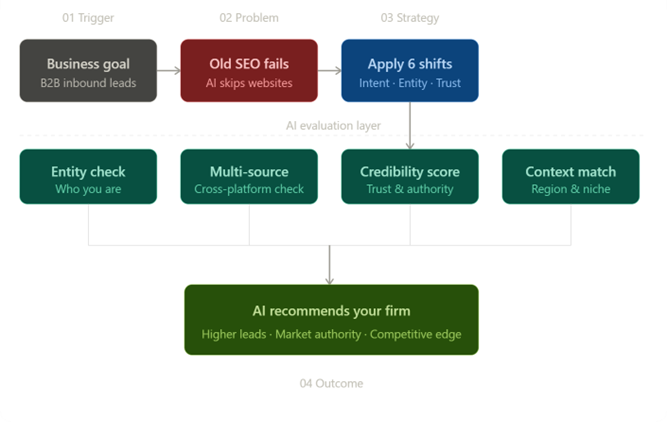
AI systems do not simply match keywords. They evaluate:
- Who you are
- What you specialize in
- Where you operate
- How credible is your information
For collections firms, this means your online presence must clearly communicate expertise, specialization, and reliability across multiple channels.
Why Traditional SEO Alone Is No Longer Enough
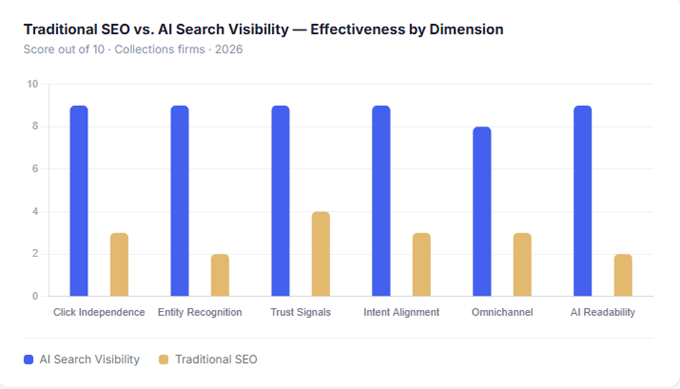
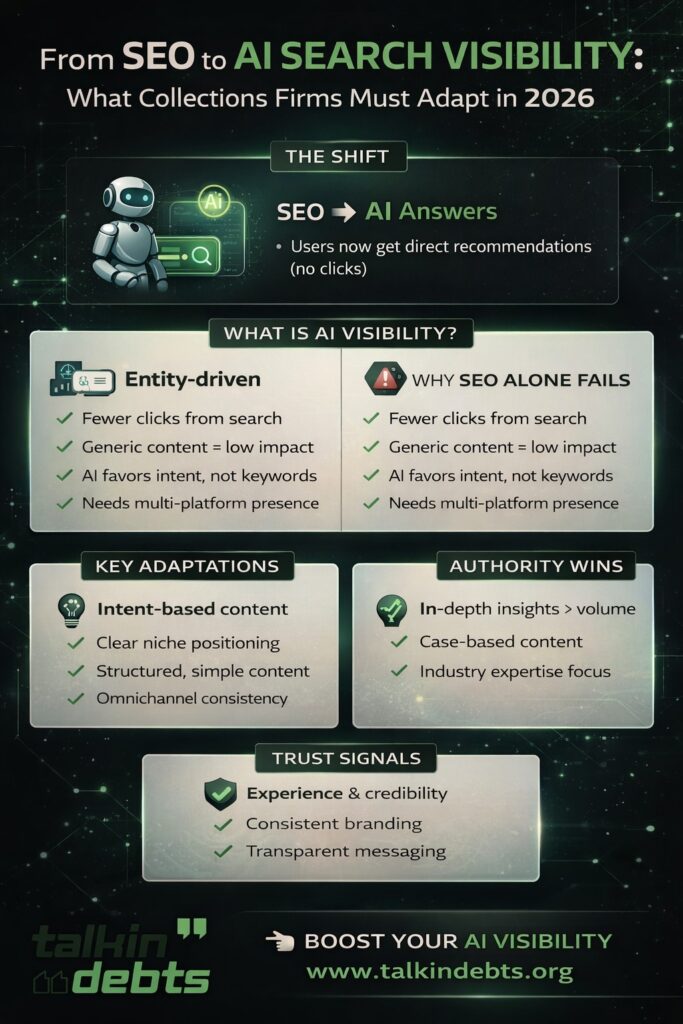
SEO is not dead—but it is no longer sufficient on its own.
Here’s why:
1. Reduced Click Dependency
AI-generated answers reduce the need for users to click on websites. Even if you rank well, users may never visit your page.
2. Content Commoditization
Basic SEO content is everywhere. Generic blogs no longer differentiate your firm.
3. AI Interpretation Over Keyword Matching
Search engines now prioritize meaning, intent, and authority rather than exact keyword usage.
4. Multi-Source Validation
AI pulls data from various platforms—not just your website. If your presence is inconsistent, your credibility decreases.
Core Shift #1: From Keywords to Search Intent and Expertise
In 2026, keyword stuffing and basic optimization tactics are ineffective.
Collections firms must focus on intent-driven content.
Instead of writing generic pages targeting “debt collection services,” create content that answers specific, high-value questions:
- When should a business outsource debt collection?
- What are the compliance risks in commercial debt recovery?
- How does early-stage recovery improve cash flow?
This approach aligns with how AI systems process information—by identifying meaningful, context-rich answers.
Core Shift #2: Entity-Based Optimization
AI systems treat your business as an entity, not just a website.
An entity is defined by:
- Your company name
- Your services
- Your specialization
- Your geographic focus
- Your reputation
To strengthen your entity presence:
- Use consistent business descriptions across all platforms
- Clearly define your niche (e.g., B2B collections, specific regions)
- Ensure your brand is associated with key industry topics
For example, positioning your firm as:
- Specialists in commercial debt recovery
- Experts in early-stage receivables management
- Focused on Australia or Kerala markets
This clarity helps AI systems understand when to recommend your firm.
Core Shift #3: Structured and AI-Friendly Content
AI systems prefer content that is easy to interpret.
To improve AI visibility:
- Use clear headings and logical structure
- Provide concise, direct answers
- Break information into digestible sections
- Avoid unnecessary jargon
Content should be written for clarity, not complexity.
Well-structured content increases the likelihood of being extracted and presented in AI-generated responses.
Core Shift #4: Omnichannel Presence is Critical
Your website alone is no longer sufficient.
AI systems gather and validate information from:
- Business directories
- Industry platforms
- News mentions
- Case studies
Collections firms must ensure:
- Consistent messaging across all platforms
- Accurate and updated business information
- Clear service descriptions everywhere
This consistency builds trust and strengthens your AI visibility.
Core Shift #5: Authority Content Over Volume
Publishing large volumes of low-quality content is ineffective.
Instead, focus on:
- In-depth industry insights
- Detailed service explanations
- Real-world case examples
- Thought leadership articles
For example:
- A comprehensive guide on B2B debt recovery processes
- Insights into payment behavior trends in specific regions
- Analysis of regulatory requirements
High-quality content signals expertise and increases your chances of being referenced by AI.
Core Shift #6: Trust and Credibility Signals
Trust is a major factor in AI-driven recommendations.
Collections firms must demonstrate:
- Experience and industry knowledge
- Transparent processes
- Professional credibility
- Consistent communication
Ways to build trust:
- Publish case studies (without sensitive data)
- Highlight years of experience
- Showcase team expertise
- Maintain professional branding
The stronger your trust signals, the more likely AI systems will recommend your firm.
The Role of AI in B2B Decision-Making
AI is becoming a key tool for procurement teams and finance professionals.
Before engaging with a collection agency, decision-makers may use AI to:
- Identify potential service providers
- Compare expertise and specialization
- Evaluate credibility
This means your firm must be visible before direct contact happens.
If AI does not recognize your firm as relevant, you are excluded from early-stage consideration.
Practical Strategy for Collections Firms in 2026
To adapt effectively, collections firms should implement the following:
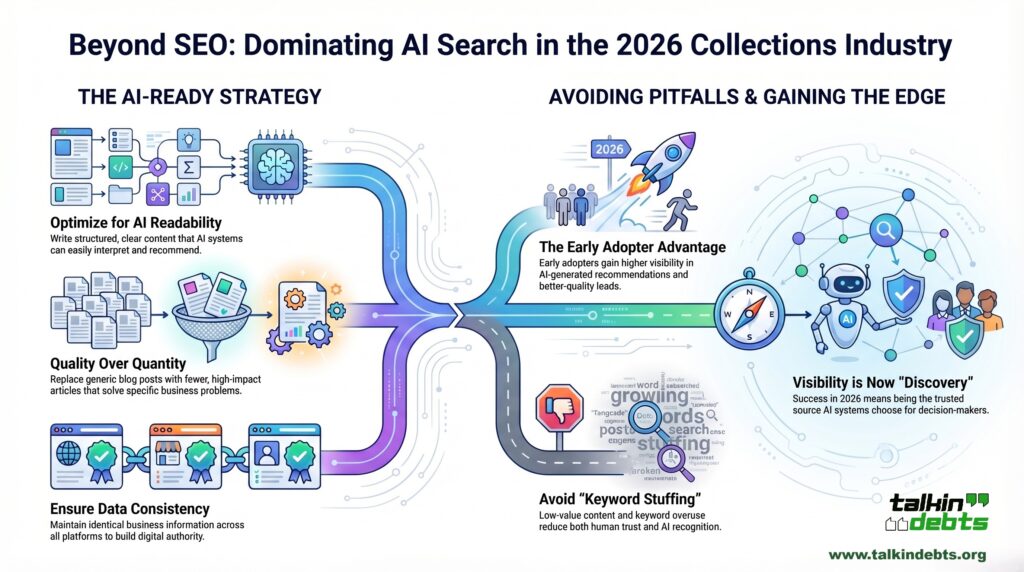
1. Redefine Your Content Strategy
Focus on solving real business problems rather than targeting generic keywords.
2. Strengthen Brand Positioning
Clearly communicate your specialization and unique strengths.
3. Ensure Data Consistency
Maintain identical business information across all platforms.
4. Invest in High-Value Content
Create fewer but more impactful articles and insights.
5. Optimize for AI Readability
Write content that is structured, clear, and easy to interpret.
6. Build Digital Authority
Expand your presence beyond your website to multiple platforms.
Common Mistakes to Avoid
Many collections firms are still relying on outdated strategies.
Avoid these pitfalls:
- Publishing generic, low-value blog content
- Ignoring platform consistency
- Overusing keywords without context
- Failing to define a clear niche
- Treating SEO as a one-time effort
These mistakes reduce both search visibility and AI recognition.
Competitive Advantage in Early Adoption
Firms that adapt early to AI-driven visibility will gain a strong competitive edge.
Key advantages include:
- Higher visibility in AI-generated recommendations
- Increased inbound leads
- Stronger authority in the market
- Better-quality client inquiries
Early adopters position themselves as industry leaders while competitors struggle to catch up.
The Future of Visibility in the Collections Industry
The future is clear: search is evolving into intelligent discovery.
AI systems will continue to:
- Replace traditional search behaviors
- Deliver instant recommendations
- Prioritize trusted and authoritative sources
For collections firms, success will depend on:
- Clarity of communication
- Depth of expertise
- Consistency across platforms
- Alignment with AI-driven systems
Closing Insight
The transition from SEO to AI search visibility is not just a marketing shift—it is a strategic transformation.
Collections firms that continue relying solely on traditional SEO will face declining visibility and missed opportunities. Those that embrace AI-driven discovery will not only remain competitive but will lead the market.
In 2026, visibility is no longer about ranking on a page.
It is about being recognized, trusted, and recommended by AI systems that shape decision-making.
And in a results-driven industry like debt collection, that visibility directly translates into growth, authority, and long-term success.