Building an AI-Driven Collections Strategy: The Technology Stack Every Agency Needs
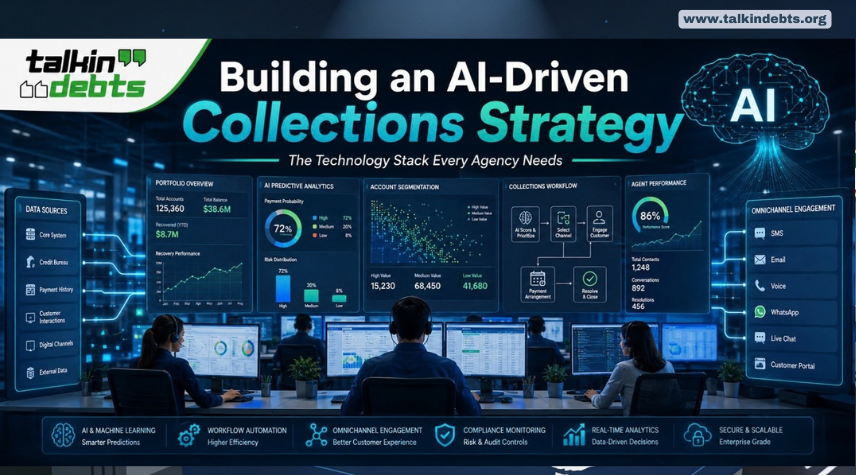
The Collections Industry Is Entering an AI-First Era
Debt collection agencies and debt buyers are facing increasing pressure to improve recovery rates while maintaining compliance, reducing operational costs, and delivering better customer experiences. Traditional collection methods that rely heavily on manual processes, static workflows, and agent intuition are becoming less effective in a rapidly changing financial environment.
Artificial intelligence is transforming the collections industry by enabling agencies to automate routine tasks, prioritize accounts more accurately, personalize customer engagement, and make data-driven decisions at scale.
However, implementing AI successfully requires more than simply purchasing a new software platform. Agencies need a well-planned AI collections strategy supported by the right technology stack.
This guide explores the essential components of a modern debt collection technology stack and how agencies can build an AI-powered collections operation that delivers measurable results.
What Is an AI Collections Strategy?
An AI collections strategy is the use of artificial intelligence, machine learning, automation, and advanced analytics to optimize every stage of the debt collection lifecycle.
Instead of treating all accounts the same, AI helps agencies:
- Predict which customers are most likely to pay
- Identify optimal contact channels
- Determine the best time to engage borrowers
- Automate routine communications
- Prioritize accounts based on recovery probability
- Improve compliance monitoring
- Enhance agent productivity
The goal is simple: recover more debt while reducing operational costs and improving customer outcomes.
Why Traditional Collection Models Are Struggling
Many agencies still rely on legacy systems that create operational bottlenecks.
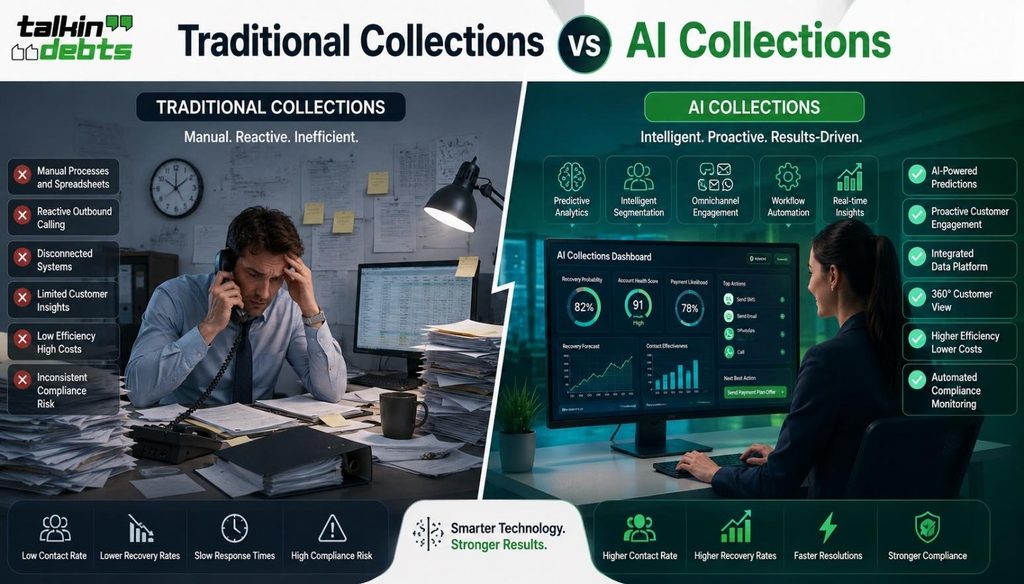
Common challenges include:
Manual Account Prioritization
Collectors often work accounts based on aging reports rather than payment likelihood.
Generic Outreach Campaigns
The same communication strategy is applied across thousands of consumers regardless of behavior or risk profile.
Limited Data Visibility
Critical customer information is often scattered across multiple systems.
Compliance Risks
Manual processes increase the chance of regulatory violations and inconsistent communications.
High Labor Costs
Collectors spend significant time on repetitive administrative tasks instead of revenue-generating activities.
AI-driven collections workflows address these issues through automation and intelligent decision-making.
Core Components of a Modern Debt Collection Technology Stack
An effective AI collections strategy relies on several interconnected technologies.
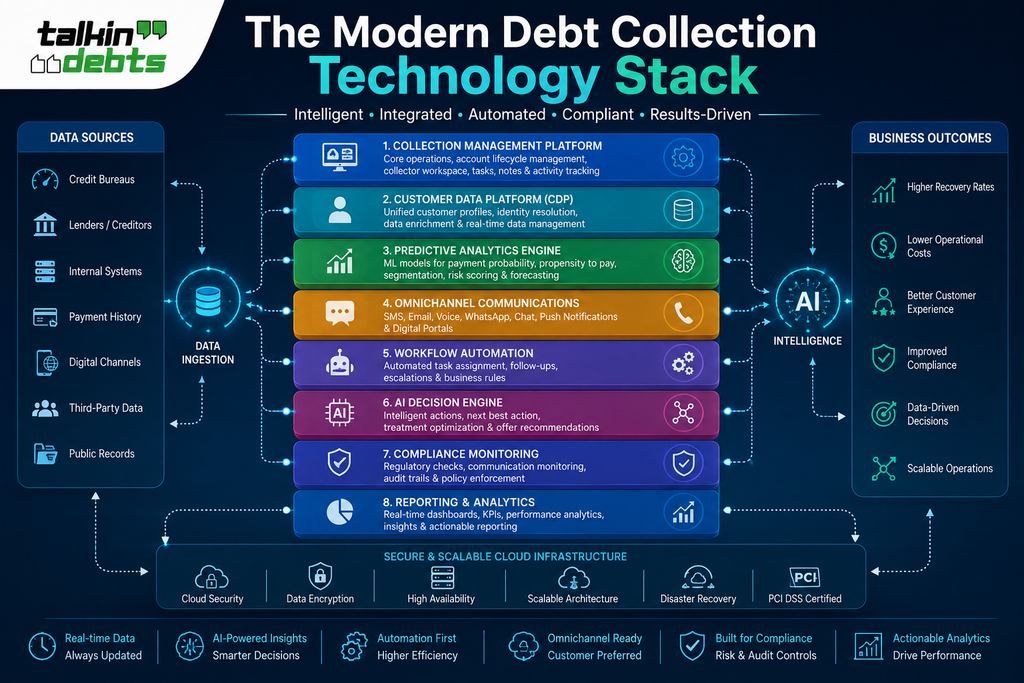
1. Collection Management Platform
The collection management platform serves as the foundation of the entire technology ecosystem.
Key capabilities include:
- Account management
- Payment tracking
- Workflow management
- Reporting dashboards
- Compliance tracking
- User management
A centralized platform ensures all collection activities are recorded and accessible across teams.
Without a strong collection management system, AI tools cannot deliver their full value.
2. Customer Data Platform (CDP)
AI is only as effective as the data it receives.
A Customer Data Platform consolidates information from:
- Credit bureaus
- Internal account systems
- Payment histories
- Customer interactions
- Digital engagement channels
- CRM systems
This unified view creates a complete borrower profile that can be used for predictive modeling and decision-making.
Benefits include:
- Better segmentation
- Improved targeting
- More accurate risk assessments
- Personalized customer experiences
3. AI-Powered Predictive Analytics Engine
Predictive analytics is the intelligence layer of the collections technology stack.
Machine learning models analyze historical data to forecast future outcomes.
Common predictions include:
Payment Probability
Identifies which consumers are most likely to pay.
Cure Probability
Predicts whether delinquent accounts will self-cure without intervention.
Settlement Likelihood
Determines which consumers may respond to settlement offers.
Roll Rate Risk
Forecasts movement into deeper delinquency stages.
These insights allow agencies to allocate resources more effectively.
4. Intelligent Segmentation System
Traditional segmentation often relies on simple criteria such as balance amount or days past due.
AI segmentation incorporates:
- Payment behavior
- Contact responsiveness
- Demographic patterns
- Digital engagement activity
- Financial indicators
This enables agencies to create highly targeted collection strategies for different customer groups.
For example:
- High-probability payers may receive automated reminders.
- Medium-risk accounts may receive digital engagement campaigns.
- High-value accounts may be assigned to experienced collectors.
5. Omnichannel Communication Platform
Modern consumers expect flexibility in how they communicate.
An AI-enabled communication platform should support:
- SMS
- Voice calls
- Live chat
- Customer portals
- Mobile applications
The system should intelligently select the most effective communication channel based on customer preferences and historical response rates.
Benefits include:
- Higher engagement
- Improved customer satisfaction
- Better contact rates
- Lower communication costs
The Role of Collections Workflow Automation
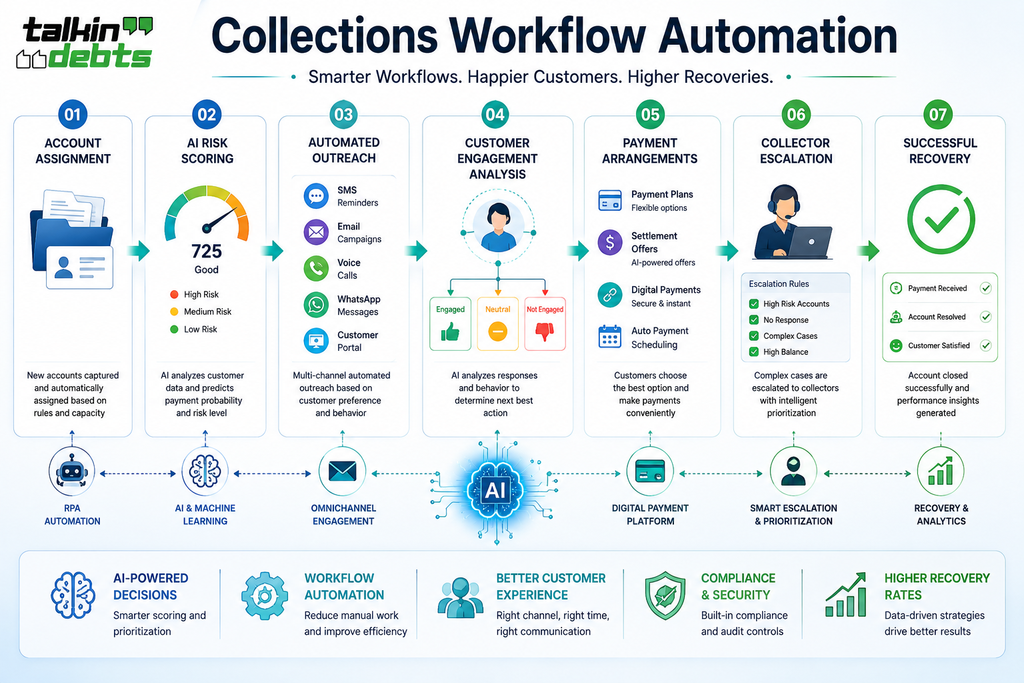
One of the most significant advantages of AI is workflow automation.
Collections workflow automation eliminates repetitive manual tasks and ensures consistent execution of collection strategies.
Automated Account Assignment
AI can route accounts to specific teams or agents based on:
- Account value
- Recovery probability
- Customer behavior
- Complexity level
Automated Payment Reminders
Customers receive timely reminders without manual intervention.
Automated Escalation Rules
Accounts can automatically move through collection stages based on predefined triggers.
Automated Follow-Ups
AI systems schedule and execute follow-up communications according to customer responses.
This reduces administrative workload and improves operational efficiency.
6. Conversational AI and Virtual Agents
Virtual agents are becoming increasingly important within collection operations.
AI-powered chatbots and voice assistants can:
- Answer account questions
- Provide payment options
- Schedule payment arrangements
- Verify account information
- Handle routine inquiries
These systems provide 24/7 support while reducing call center workloads.
Human agents can then focus on more complex collection cases.
7. Payment Processing and Self-Service Platforms
Modern consumers prefer convenient payment experiences.
An effective debt collection technology stack should include:
- Secure payment gateways
- Digital payment links
- Payment plans
- Automated recurring payments
- Self-service account portals
AI can recommend payment options based on customer affordability and payment history.
This improves both recovery rates and customer experience.
8. Compliance and Risk Monitoring Tools
Compliance remains one of the most critical aspects of debt collection.
AI-powered compliance solutions can:
- Monitor communications
- Detect regulatory violations
- Flag high-risk interactions
- Review call recordings
- Identify consumer complaints
Automated compliance monitoring helps agencies maintain consistency and reduce legal exposure.
9. Business Intelligence and Reporting Platforms
Data-driven decision-making requires robust reporting capabilities.
A modern analytics platform should provide:
- Recovery performance dashboards
- Agent productivity metrics
- Channel effectiveness reports
- Portfolio performance analysis
- Predictive forecasting
Real-time visibility allows managers to adjust strategies quickly and maximize recovery opportunities.
How AI Improves Collection Performance
When implemented correctly, AI can deliver improvements across multiple areas.
Increased Recovery Rates
Predictive models help prioritize accounts with the highest likelihood of payment.
Lower Operational Costs
Automation reduces manual workloads and improves efficiency.
Better Customer Experience
Personalized communication increases engagement and satisfaction.
Enhanced Compliance
Automated monitoring reduces regulatory risk.
Greater Scalability
AI enables agencies to manage larger portfolios without proportional staffing increases.
Building Your AI Collections Strategy: A Step-by-Step Approach
Many agencies make the mistake of attempting a complete technology overhaul at once.
A phased implementation strategy is often more effective.
Step 1: Assess Current Technology
Evaluate existing systems and identify operational gaps.
Step 2: Centralize Data
Create a unified customer data environment.
Step 3: Implement Workflow Automation
Automate repetitive collection activities.
Step 4: Deploy Predictive Analytics
Introduce AI models for prioritization and segmentation.
Step 5: Expand Omnichannel Engagement
Provide consumers with flexible communication options.
Step 6: Optimize Continuously
Use analytics to refine workflows and improve performance over time.
Common Mistakes to Avoid
Buying Technology Without a Strategy
Technology should support business objectives, not drive them.
Ignoring Data Quality
Poor data can significantly reduce AI effectiveness.
Over-Automating Customer Interactions
Human collectors remain essential for complex negotiations and sensitive situations.
Failing to Measure Results
Agencies should track key performance indicators before and after implementation.
Neglecting Staff Training
Technology adoption requires employee education and change management.
Future Trends in AI Collections Technology

The next generation of collection technology will likely include:
- Generative AI for personalized communications
- Advanced speech analytics
- Real-time payment behavior prediction
- Autonomous workflow optimization
- Emotion detection in customer interactions
- Hyper-personalized collection journeys
Agencies that invest in modern technology today will be better positioned to compete as these innovations become mainstream.
Creating a Smarter Collections Operation
The future of debt collection will be driven by intelligent automation, predictive analytics, and customer-centric engagement. Agencies that build a strong AI collections strategy supported by a modern debt collection technology stack can improve recovery rates, reduce costs, strengthen compliance, and enhance customer experiences.
Rather than viewing AI as a single tool, successful organizations treat it as an integrated ecosystem that supports every stage of the collections lifecycle. By combining predictive intelligence, workflow automation, omnichannel communications, and compliance monitoring, collection agencies can create scalable operations capable of meeting the demands of an increasingly digital financial landscape.
The agencies that begin building these capabilities today will be the ones leading the collections industry tomorrow.