Q2 Earnings Reveal How Rising Delinquencies Are Reshaping Lender Risk Strategies

Aug.2026 — The latest round of Q2 earnings from major banks and consumer lenders is providing one of the clearest signals yet that credit risk management is becoming a top priority across the financial sector. While many institutions continue to report healthy profits and resilient loan demand, executives are increasingly highlighting changing consumer payment behavior, prompting renewed focus on delinquency trends, underwriting standards, and portfolio quality.
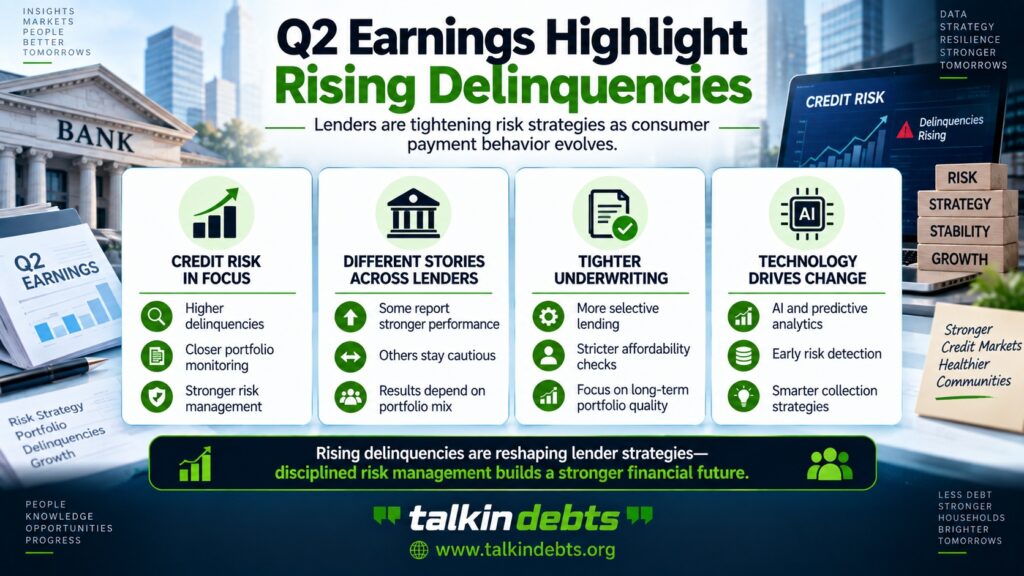
Q2 Earnings: Rising Delinquencies Reshape Lender Risk
For lenders, debt buyers, and collection agencies, this earnings season is offering more than quarterly financial results. It is becoming an industry benchmark for assessing how credit portfolios are performing as higher borrowing costs and persistent household financial pressures influence repayment patterns.
Credit Quality Remains in Focus
Throughout the Q2 reporting season, several financial institutions pointed to credit quality as a key discussion point during earnings presentations. While performance varies across loan portfolios and customer segments, lenders continue to monitor consumer credit closely as early-stage delinquencies remain above historical lows in some lending categories.
Institutions are responding by reviewing reserve levels, refining underwriting policies, and increasing investments in portfolio monitoring rather than waiting for accounts to become severely delinquent.
“The focus has shifted from simply growing loan books to protecting portfolio quality,” said one banking analyst following the latest earnings releases. “Risk management is now a competitive advantage.”
Earnings Show Different Credit Stories Across the Industry
The earnings season has also demonstrated that not all lenders are experiencing the same credit environment.
American Express, whose customer base generally consists of higher-income consumers, reported stronger spending activity alongside fewer delinquencies during the quarter, illustrating how borrower demographics continue to influence credit performance.
Meanwhile, other lenders continue to maintain cautious outlooks, strengthening reserves and carefully monitoring consumer repayment trends as economic uncertainty persists.
U.S. Bancorp reported stabilizing credit quality during the quarter, with lower non-performing assets and improving delinquency metrics compared with both the previous quarter and the same period last year, while continuing to monitor inflation, interest rates, and broader economic risks affecting borrowers.
Similarly, PNC Financial Services reported lower commercial loan delinquencies and improved non-performing loan levels during the second quarter, reflecting continued attention to portfolio quality.
The mixed results reinforce that lender performance increasingly depends on portfolio composition, borrower profile, and risk management strategy rather than broader market conditions alone.
Underwriting Standards Continue to Tighten
One consistent theme emerging from Q2 earnings lenders 2026 is a disciplined approach to new lending.
Many financial institutions are becoming more selective when approving credit, particularly within unsecured consumer lending. Risk teams are placing greater emphasis on income verification, affordability assessments, debt-to-income ratios, and behavioral credit scoring.
Rather than reducing lending activity altogether, institutions appear focused on improving long-term portfolio performance by originating higher-quality accounts.
Industry analysts say this reflects lessons learned during previous credit cycles, where early risk controls often proved more effective than expanding collections efforts after accounts became delinquent.
Technology Is Playing a Larger Role
Another recurring message from earnings calls is the growing role of technology in credit risk management.
Banks continue investing in artificial intelligence, predictive analytics, and machine learning to identify early warning signs before payment issues become significant.
Modern risk platforms now evaluate thousands of customer data points, including payment behavior, account utilization, spending patterns, and customer engagement, enabling lenders to intervene earlier and allocate collection resources more effectively.
Executives increasingly describe these technologies as strategic investments rather than operational enhancements.
Collections Strategies Are Moving Earlier
The latest earnings reports also suggest that collections strategies are evolving.
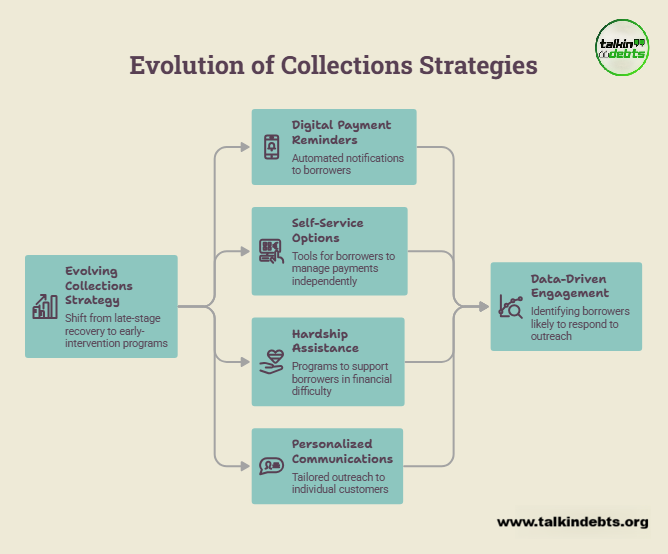
Instead of concentrating primarily on late-stage recoveries, many lenders are expanding early-intervention programs designed to engage borrowers before accounts progress into more serious delinquency stages.
Digital payment reminders, self-service payment options, hardship assistance programs, and personalized customer communications are becoming standard components of collection strategies aimed at improving recovery outcomes while maintaining customer relationships.
For collection agencies servicing financial institutions, this shift is creating greater demand for data-driven engagement models capable of identifying borrowers most likely to respond to proactive outreach.
What It Means for Debt Buyers
Debt buyers are also closely watching the Q2 earnings season.
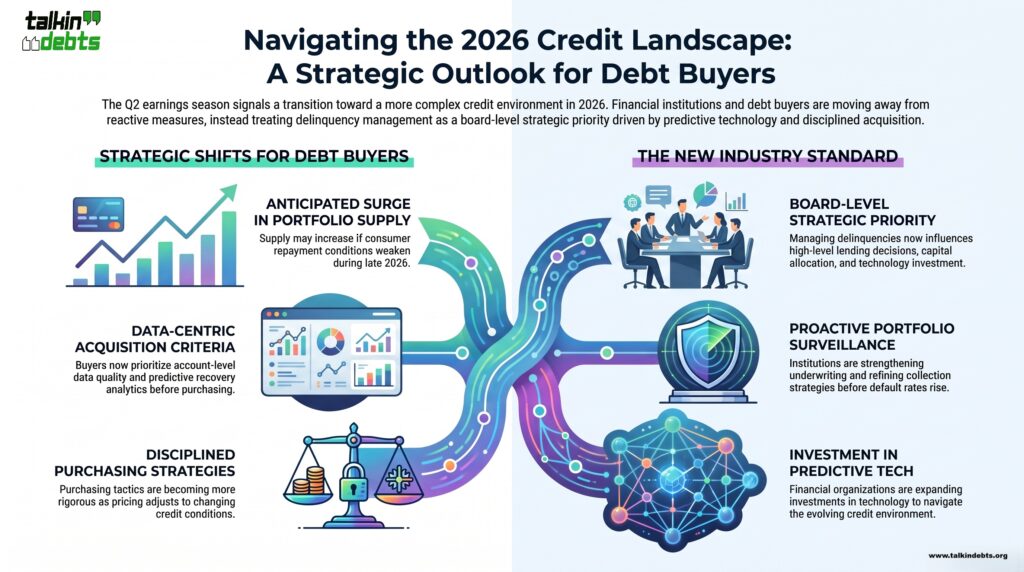
While charge-off volumes remain manageable across much of the industry, analysts believe portfolio supply could increase if consumer repayment conditions weaken during the second half of 2026.
At the same time, buyers continue placing greater emphasis on portfolio documentation, account-level data quality, historical payment performance, and predictive recovery analytics before making acquisition decisions.
Market participants say disciplined purchasing strategies are becoming increasingly important as pricing adjusts to changing credit conditions.
The Industry Outlook
Although many lenders continue to report solid profitability, the Q2 earnings season highlights an industry preparing for a more complex credit environment.
Rather than reacting only after defaults rise, financial institutions are strengthening underwriting, increasing portfolio surveillance, refining collection strategies, and expanding investments in predictive technologies.
For lenders, debt buyers, and collections organizations, the latest earnings reports offer an important reminder that managing rising delinquencies is no longer solely the responsibility of collections teams. It has become a board-level strategic priority influencing lending decisions, technology investment, capital allocation, and long-term portfolio performance.
As additional institutions report results over the coming weeks, market participants will continue watching delinquency trends, loan-loss provisions, and consumer repayment behavior for further signs of how lender risk strategies are evolving through the remainder of 2026.