AI vs Traditional Credit Risk Models: Which Delivers Better Results for Modern Lenders?
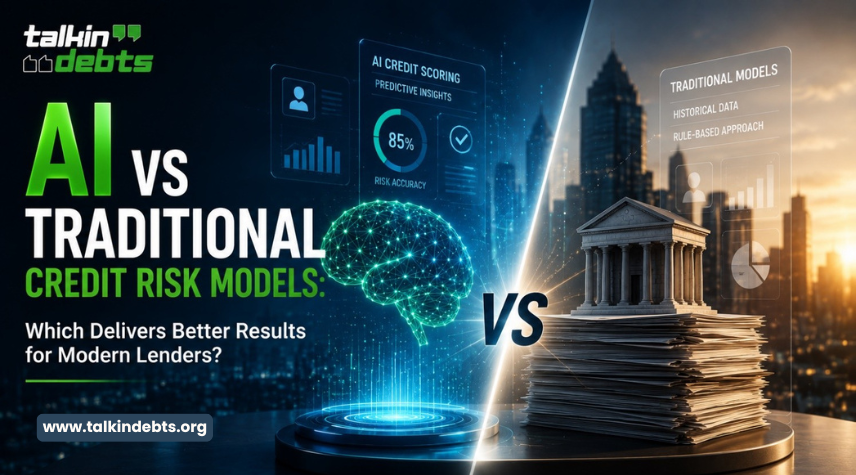
The lending industry is experiencing one of the most significant transformations in its history. As financial institutions face increasing pressure to make faster, more accurate, and more inclusive lending decisions, traditional credit assessment methods are being challenged by artificial intelligence. Today’s lenders are no longer asking whether AI should be part of their credit strategy—they are asking how quickly they can adopt it without increasing risk.
For decades, traditional credit risk models have served as the foundation of lending decisions. These models rely on historical credit reports, income verification, debt-to-income ratios, and standardized statistical methods to evaluate borrower risk. While these systems have proven effective over time, they often struggle to keep pace with rapidly changing financial behaviors and the growing demand for instant lending.
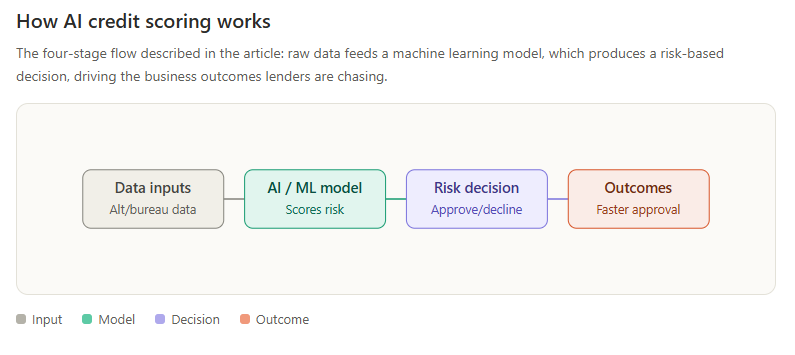
In contrast, AI credit scoring combines machine learning, predictive analytics, and vast amounts of structured and unstructured data to evaluate creditworthiness with greater precision. Powered by advanced credit risk analytics software, AI enables lenders to identify patterns that conventional models often miss.
The question is no longer whether AI is innovative. The real question is whether AI delivers better results than traditional credit risk models—and if so, where the greatest advantages lie.
This article explores the strengths, limitations, and real-world impact of both approaches while helping modern lenders determine which strategy best supports sustainable growth.
Understanding Traditional Credit Risk Models
Traditional credit risk models have been the backbone of banking for decades. These systems primarily depend on historical financial information and predefined statistical methodologies to estimate the likelihood of borrower default.
Typical inputs include:
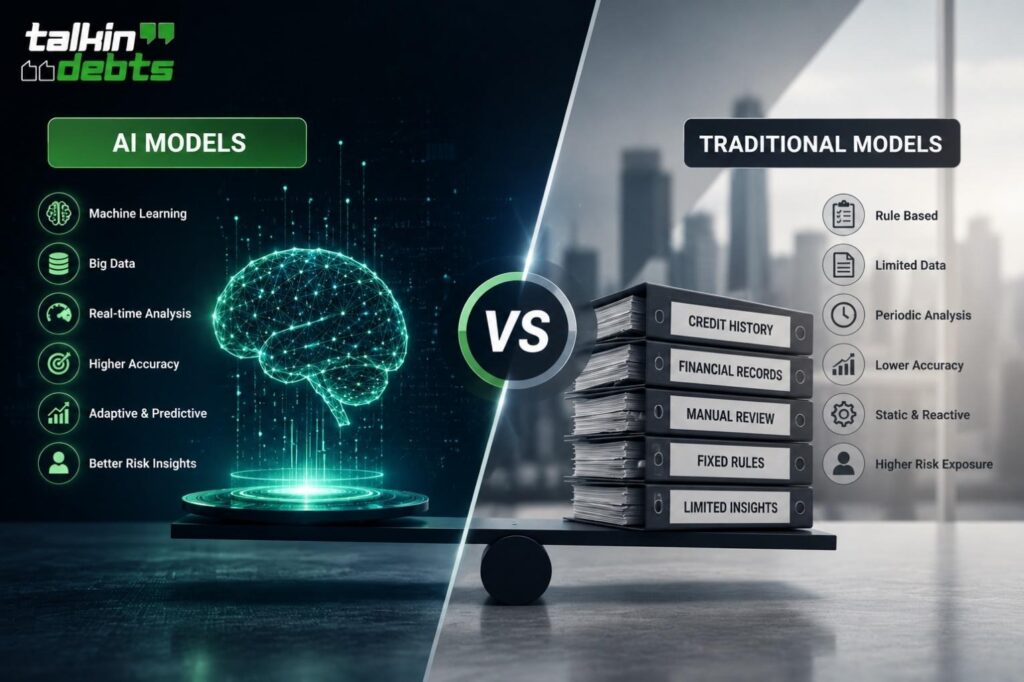
- Credit history
- Repayment behavior
- Debt-to-income ratio
- Employment history
- Outstanding liabilities
- Credit utilization
- Public financial records
Common statistical techniques include logistic regression, scorecards, and probability-of-default calculations.
These models are highly standardized, making them easier to explain to regulators and auditors. Because of their transparency, banks have relied on them for years to maintain compliance and consistency.
However, financial markets have evolved considerably. Consumer behavior has changed, digital banking has expanded, and new borrower segments often lack extensive credit histories. These developments expose several weaknesses in conventional models.
The Rise of AI Credit Scoring
Artificial intelligence introduces a fundamentally different approach to credit assessment.
Rather than relying solely on predefined formulas, AI systems continuously learn from new data. Advanced machine learning credit models recognize relationships between thousands of variables, enabling lenders to make far more accurate predictions.
Modern AI credit scoring platforms analyze data such as:
- Banking transaction history
- Cash flow patterns
- Spending behavior
- Utility payments
- Mobile payment activity
- Digital wallet usage
- Business financial data
- Device behavior
- Alternative financial indicators
Instead of following fixed rules, AI continuously improves as new lending outcomes become available.
This adaptive capability allows lenders to respond more effectively to changing economic conditions.
Comparing AI and Traditional Credit Risk Models
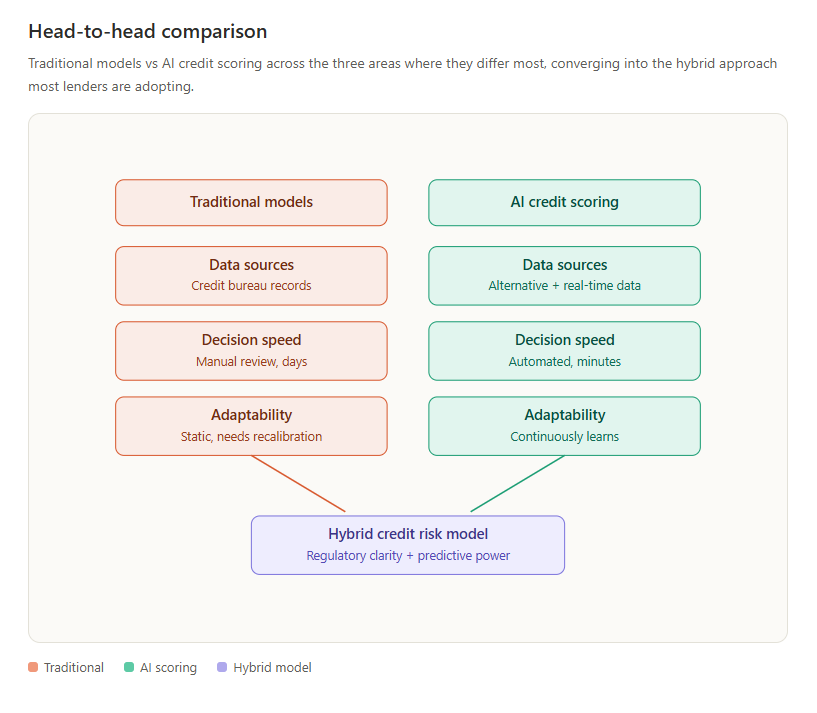
Data Sources
Traditional models typically depend on credit bureau information and financial statements.
AI models expand the data universe significantly by incorporating alternative data, behavioral analytics, and real-time financial activity.
This broader perspective creates a more complete borrower profile.
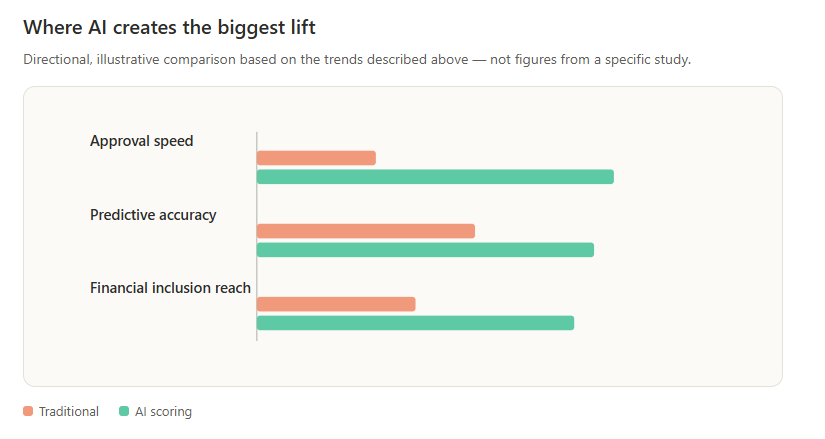
Speed of Decision Making
Traditional underwriting often requires manual reviews, document verification, and multiple approval stages.
AI automates much of this process.
Many fintech lenders can approve loans within minutes using automated AI credit scoring systems.
Faster decisions improve customer satisfaction while reducing operational costs.
Predictive Accuracy
One of the biggest advantages of AI lies in predictive performance.
Machine learning algorithms continuously identify new relationships between borrower behavior and repayment outcomes.
As lending portfolios grow, the models become increasingly accurate.
Traditional statistical models remain largely static unless manually recalibrated.
Adaptability
Economic conditions change rapidly.
Inflation, employment shifts, and consumer spending patterns can affect borrower behavior almost overnight.
Traditional models often require months of redevelopment before reflecting these changes.
AI models continuously learn from recent lending performance, making them far more adaptable.
Scalability
As lenders expand into new markets or introduce new products, traditional scorecards often require extensive redevelopment.
AI systems can scale across millions of customers while adapting to different lending products and borrower profiles.
This flexibility supports rapid business growth.
Where Traditional Models Still Excel
Despite AI’s advantages, traditional credit risk models continue to provide value in several areas.
Regulatory Transparency
Traditional statistical methods are relatively easy to explain.
Regulators appreciate models whose decision logic can be clearly documented.
AI models, particularly deep learning systems, sometimes face criticism for operating as “black boxes.”
However, explainable AI technologies are helping address this concern.
Stability
Traditional models perform consistently in stable lending environments where borrower behavior changes gradually.
Banks with mature customer portfolios may continue achieving acceptable performance using conventional approaches.
Lower Implementation Complexity
Many financial institutions already possess established infrastructure supporting traditional underwriting.
Migrating to AI requires investment in technology, data management, governance, and employee training.
Why AI Is Changing Credit Risk Analytics
Several industry trends are accelerating AI adoption.
Growing Digital Lending
Consumers increasingly expect instant approvals.
AI makes real-time lending possible without sacrificing risk management quality.
Increasing Data Availability
Financial institutions now have access to enormous amounts of transaction data.
Advanced credit risk analytics software transforms this information into meaningful lending insights.
Financial Inclusion
Millions of borrowers have limited or nonexistent traditional credit histories.
AI evaluates alternative indicators that allow lenders to assess these applicants more accurately.
This expands lending opportunities while maintaining portfolio quality.
Fraud Detection
AI models detect unusual behavioral patterns that often indicate fraud.
Traditional models generally focus on repayment risk rather than identity fraud.
Combining fraud analytics with AI credit scoring creates stronger protection against financial crime.
Machine Learning Credit Models in Action
Modern lenders use machine learning across multiple lending activities.
Examples include:
- Personal loan underwriting
- Credit card approvals
- Mortgage prequalification
- Small business lending
- Buy Now Pay Later platforms
- Embedded finance
- Digital banking
- Commercial lending
In each case, AI analyzes vast datasets far beyond human capability.
The result is improved prediction accuracy and faster lending decisions.
Challenges of AI Credit Scoring
Although AI delivers significant benefits, implementation requires careful planning.
Data Quality
Machine learning depends on high-quality data.
Poor data governance reduces model accuracy.
Organizations must invest in data cleansing, integration, and validation.
Explainability
Financial regulators increasingly require lenders to explain automated decisions.
Modern explainable AI tools help provide transparency while maintaining predictive performance.
Bias Management
AI systems can unintentionally inherit historical biases from training data.
Responsible lenders regularly monitor models for fairness and implement bias mitigation strategies.
Governance
AI requires ongoing monitoring.
Unlike static scorecards, machine learning models continuously evolve.
Strong governance ensures models remain compliant, accurate, and reliable.
The Business Benefits of AI Credit Risk Analytics
Organizations adopting AI often experience measurable improvements across key performance indicators.
Benefits include:
- Higher approval accuracy
- Lower default rates
- Faster loan processing
- Improved operational efficiency
- Better customer experience
- Enhanced fraud detection
- Greater financial inclusion
- Reduced underwriting costs
- Improved portfolio performance
- Better risk-adjusted profitability
These advantages explain why banks, fintech companies, and digital lenders continue increasing AI investments.
Hybrid Models: The Best of Both Worlds
Many financial institutions are not replacing traditional models entirely.
Instead, they combine conventional scorecards with AI.
Hybrid credit risk frameworks offer several advantages:
- Regulatory familiarity
- Improved predictive performance
- Easier implementation
- Reduced operational risk
- Better customer segmentation
Traditional models provide explainability.
AI provides enhanced predictive intelligence.
Together, they create stronger lending decisions.
The Future of Credit Risk Management
Credit risk management is evolving toward intelligent, data-driven decision-making.
Emerging technologies will further strengthen AI capabilities, including:
- Real-time risk monitoring
- Continuous borrower assessment
- Behavioral analytics
- Graph analytics
- Generative AI-assisted underwriting
- Explainable AI
- Federated learning
- Privacy-preserving machine learning
These innovations will enable lenders to make increasingly personalized and accurate lending decisions.
As competition intensifies, institutions relying solely on traditional scorecards may struggle to maintain their competitive advantage.
Which Model Delivers Better Results?
The answer depends on the lender’s objectives.
Traditional credit risk models remain valuable for organizations prioritizing stability, simplicity, and regulatory familiarity.
However, lenders seeking faster approvals, improved prediction accuracy, expanded financial inclusion, and stronger operational efficiency increasingly find AI to be the superior choice.
Modern machine learning credit models can evaluate significantly more information than conventional scorecards while continuously adapting to changing borrower behavior.
The most successful financial institutions are adopting hybrid approaches that combine proven statistical methods with advanced AI capabilities.
This strategy delivers the transparency regulators expect while unlocking the predictive power necessary for today’s digital lending environment.
Preparing for the Future of Lending The future of lending belongs to organizations that can balance innovation with responsible risk management. While traditional credit risk models have provided decades of reliable performance, they are no longer sufficient on their own in a world driven by real-time data, digital transactions, and evolving customer expectations.
AI credit scoring is transforming how financial institutions assess borrowers by uncovering hidden patterns, improving decision accuracy, and enabling faster, more inclusive lending. Supported by modern credit risk analytics software and advanced fintech risk management practices, AI helps lenders reduce defaults, detect fraud more effectively, and optimize portfolio performance.
Rather than viewing AI and traditional models as competing technologies, forward-thinking lenders recognize that the greatest value often comes from combining both. A hybrid approach leverages the transparency and regulatory confidence of traditional methods while harnessing the predictive intelligence of machine learning credit models.
As the financial services industry continues to evolve, lenders that invest in intelligent risk management today will be better positioned to improve customer experiences, strengthen profitability, and remain competitive in an increasingly digital marketplace.