Global Debt Markets in Crisis: How the Middle East War Is Reshaping Sovereign and Corporate Borrowing Targets
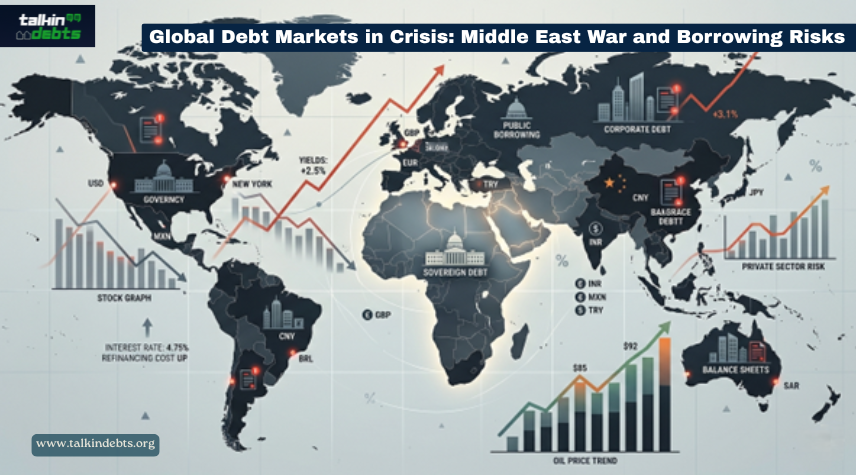
The global debt landscape is entering one of its most volatile phases in decades. What began as a regional geopolitical conflict has rapidly evolved into a catalyst for structural shifts across sovereign and corporate borrowing markets. The ongoing Middle East war is no longer just a political or humanitarian crisis—it is a financial shockwave that is redefining risk, liquidity, and capital allocation worldwide.
For lenders, investors, and policymakers, the implications are profound. From rising bond yields to tightening credit conditions and recalibrated borrowing strategies, the global debt market trends of 2026 reflect a system under pressure and transformation.
A Fragile Global Debt System Before the Shock
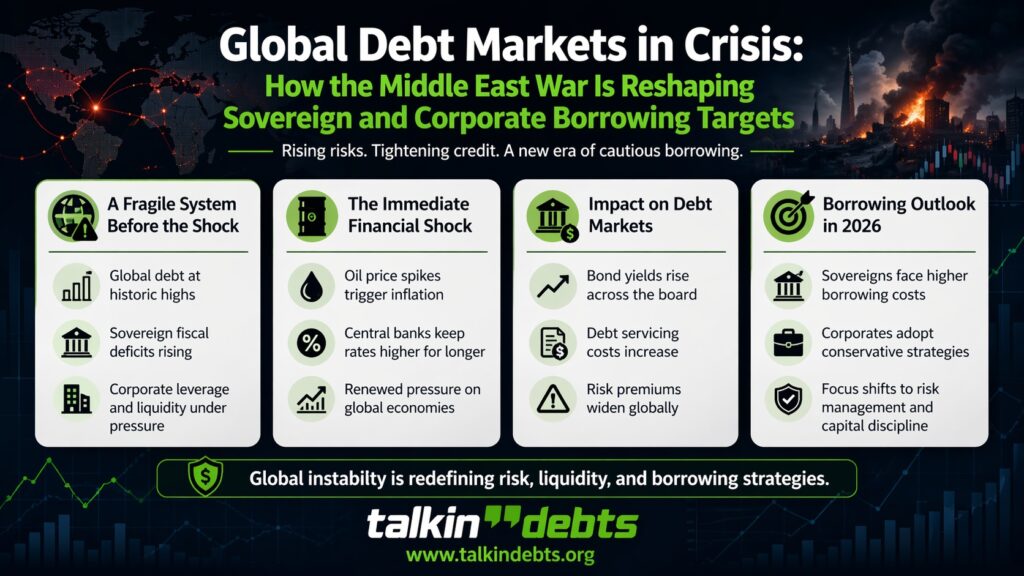
Even before the escalation in the Middle East, global debt markets were showing signs of stress. Total global debt had already crossed historic highs, driven by pandemic-era stimulus, prolonged low interest rates, and aggressive corporate borrowing.
Sovereigns were grappling with fiscal deficits, while corporations—particularly in emerging markets—were heavily leveraged. Central banks had begun tightening monetary policy to combat inflation, leading to higher borrowing costs and reduced liquidity.
The system was vulnerable. The war acted as an accelerant.
The Immediate Financial Shock: Oil, Inflation, and Interest Rates
The Middle East plays a critical role in global energy supply. Any disruption in the region immediately impacts oil prices, and that impact has been swift and severe.
Oil price spikes have triggered renewed inflationary pressures across major economies. As inflation rises, central banks are forced to maintain or even increase interest rates, delaying any anticipated monetary easing.
This creates a cascading effect on debt markets:
- Higher interest rates increase the cost of servicing existing debt
- New borrowing becomes more expensive for both governments and corporations
- Investors demand higher yields to compensate for increased risk
The result is a tightening of financial conditions globally.
Sovereign Debt Crisis 2026: Rising Default Risks
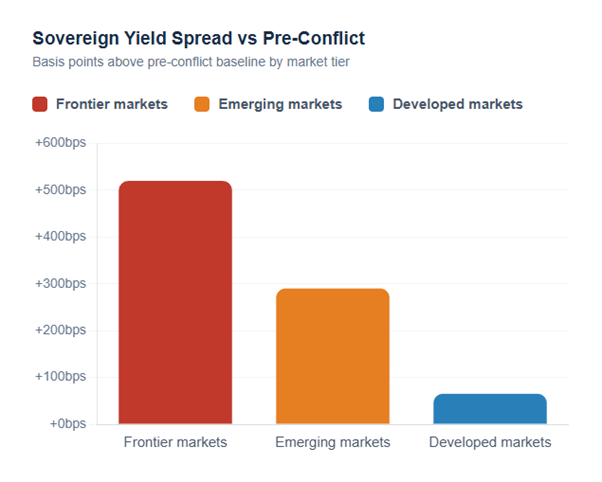
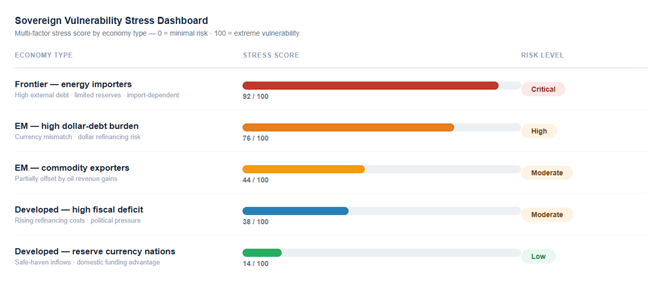
The most immediate concern lies within sovereign debt markets, particularly among emerging and developing economies.
Countries with high external debt, limited foreign reserves, and dependence on energy imports are facing a perfect storm. Rising oil prices increase import bills, while higher interest rates make debt refinancing more difficult.
Several warning signs are emerging:
- Sovereign bond yields are rising sharply
- Credit rating downgrades are increasing
- Debt restructuring discussions are becoming more frequent
For many nations, the ability to roll over existing debt is becoming increasingly uncertain. The sovereign debt crisis of 2026 is not a hypothetical scenario—it is unfolding in real time.
Flight to Safety: Capital Reallocation Trends
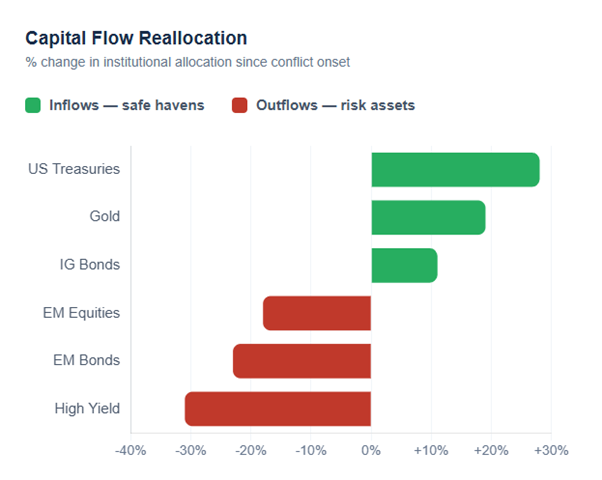
In times of geopolitical uncertainty, global capital tends to move toward perceived safe havens. This pattern is clearly visible in current global debt market trends.
Investors are shifting funds toward:
- US Treasury bonds
- Gold and other safe-haven assets
- Stable, high-credit sovereign markets
While this benefits developed economies, it creates capital outflows from emerging markets, exacerbating their financial vulnerabilities.
This reallocation has two major consequences:
- Emerging market currencies weaken, increasing the burden of dollar-denominated debt
- Access to international capital markets becomes more restricted
The divide between strong and weak economies is widening.
Corporate Borrowing Risk: A New Reality
Corporations are facing a dramatically altered borrowing environment. The combination of high interest rates, geopolitical uncertainty, and supply chain disruptions is increasing corporate borrowing risk across sectors.
Key challenges include:
- Increased cost of capital
- Reduced investor appetite for high-yield debt
- Tightened lending standards from financial institutions
Industries heavily dependent on global trade, energy, or regional stability are particularly exposed. Companies with significant exposure to the Middle East or reliant on energy-intensive operations are experiencing margin pressures and liquidity constraints.
Highly leveraged firms are at the greatest risk. Refinancing debt at higher interest rates can significantly impact profitability and, in some cases, threaten solvency.
The Rise of Risk Premiums Across Markets
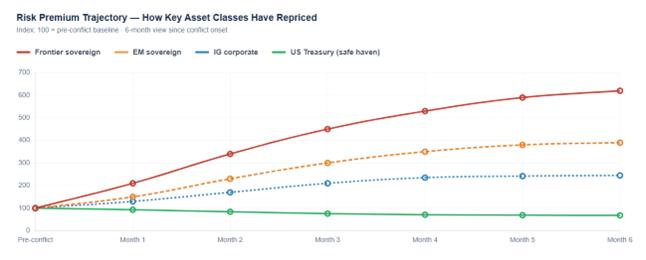
Risk is being repriced across the global financial system. Investors are demanding higher returns to compensate for geopolitical uncertainty and economic instability.
This is evident in:
- Wider credit spreads in corporate bond markets
- Increased yields on sovereign debt
- Higher borrowing costs across all asset classes
Risk premiums are no longer driven solely by economic indicators. Geopolitical risk has become a central factor in financial decision-making.
This shift is likely to persist, fundamentally altering how debt is priced and managed.
Banking Sector Response: Tightening Credit Conditions
Banks are responding cautiously to the evolving environment. With increased uncertainty and rising default risks, lending institutions are tightening credit standards.
This includes:
- More stringent borrower assessments
- Reduced exposure to high-risk regions and sectors
- Higher collateral requirements
For businesses and governments alike, access to financing is becoming more selective and conditional.
This tightening of credit further amplifies the challenges faced by borrowers, creating a feedback loop that reinforces financial stress.
Currency Volatility and Debt Servicing Pressures
Currency markets are experiencing heightened volatility as a result of the conflict. Exchange rate fluctuations are adding another layer of complexity to debt servicing, particularly for countries and corporations with foreign currency liabilities.
A weakening domestic currency means:
- Higher repayment costs for dollar-denominated debt
- Increased pressure on foreign reserves
- Greater risk of balance of payments crises
This dynamic is particularly acute in emerging markets, where currency depreciation can quickly escalate into broader financial instability.
Strategic Shifts in Sovereign Borrowing
Governments are being forced to rethink their borrowing strategies in response to the changing landscape.
Key trends include:
- Increased reliance on domestic borrowing
- Diversification of funding sources
- Greater emphasis on fiscal discipline
Some countries are also exploring alternative financing mechanisms, including bilateral agreements and regional funding arrangements, to reduce dependence on volatile global markets.
The era of easy access to cheap international capital is over—for now.
Corporate Strategy: Deleveraging and Risk Management
Corporations are adapting by focusing on financial resilience. The emphasis is shifting from aggressive expansion to balance sheet strength.
Common strategies include:
- Deleveraging and reducing debt exposure
- Extending debt maturities to manage refinancing risk
- Hedging against currency and interest rate fluctuations
Companies are also reassessing investment plans, prioritizing projects with stable returns and lower risk profiles.
This shift may slow economic growth in the short term, but could lead to more sustainable financial structures in the long run.
The Role of Institutional Investors
Institutional investors are playing a critical role in shaping global debt market trends. Their allocation decisions influence liquidity, pricing, and risk perception across markets.
In the current environment, institutional behavior is characterized by:
- Increased risk aversion
- Preference for high-quality assets
- Greater scrutiny of geopolitical exposure
This cautious approach is contributing to reduced liquidity in riskier segments of the debt market, further amplifying volatility.
Long-Term Structural Changes in Debt Markets
The impact of the Middle East war is not limited to short-term disruptions. It is driving long-term structural changes that will shape the future of global debt markets.
These include:
- Greater integration of geopolitical risk into financial models
- Increased diversification of energy sources to reduce dependency
- Enhanced focus on fiscal sustainability and debt management
The global financial system is becoming more complex, interconnected, and sensitive to external shocks.
Opportunities Amid the Crisis
Despite the challenges, the current environment also presents opportunities for strategic investors and forward-thinking institutions.
Potential opportunities include:
- Investing in undervalued assets in distressed markets
- Supporting debt restructuring initiatives
- Capitalizing on shifts in energy and infrastructure investment
Those who can accurately assess risk and adapt to changing conditions may find significant value in the evolving landscape.
What Lies Ahead for Global Debt Markets
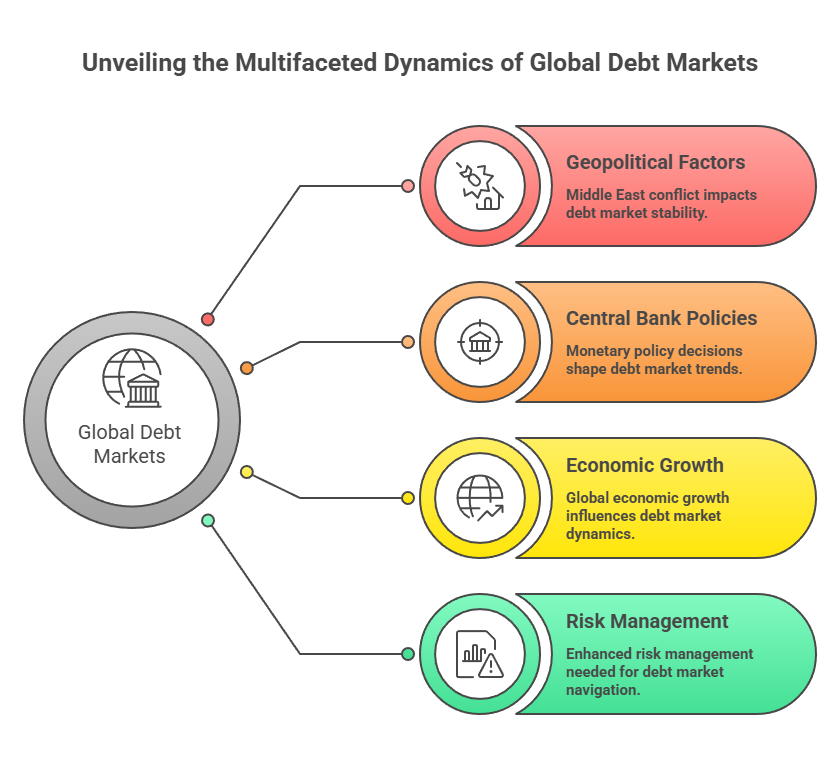
The trajectory of global debt markets will depend on several key factors:
- The duration and escalation of the Middle East conflict
- Central bank policy decisions
- Global economic growth trends
Uncertainty remains high, and volatility is likely to persist.
What is clear, however, is that the global debt market is undergoing a fundamental transformation. The interplay between geopolitics and finance is becoming increasingly pronounced, requiring a more nuanced and dynamic approach to risk management and investment.
Navigating the New Debt Reality
For lenders, investors, and policymakers, navigating this new environment requires a shift in perspective.
Traditional models based solely on economic indicators are no longer sufficient. A broader understanding of geopolitical dynamics, market sentiment, and systemic risk is essential.
Key priorities moving forward include:
- Strengthening risk assessment frameworks
- Enhancing transparency and data analysis
- Building resilience against external shocks
The global debt market is not just in crisis—it is evolving. Those who recognize and adapt to these changes will be better positioned to navigate the challenges and capitalize on emerging opportunities.