

Will the ECB’s Interest Rate Cuts Ease Debt Burdens in the Eurozone?
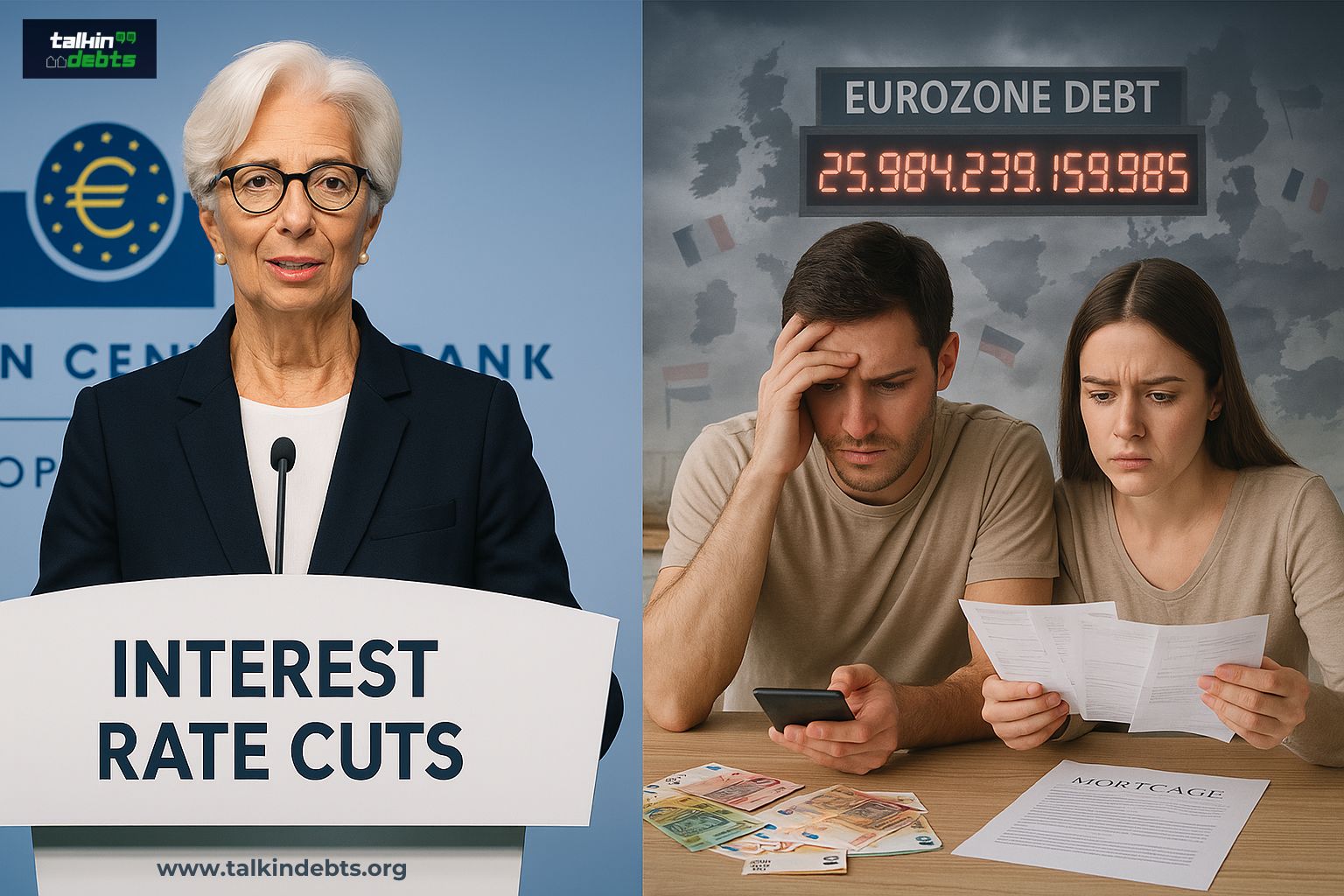
In a bold move to revive economic activity and curb deflationary pressure, the European Central Bank (ECB) has initiated a series of interest rate cuts. But the critical question remains: will these measures ease the growing debt burdens across the Eurozone?
With household debt surging and governments grappling with fiscal constraints, the Eurozone’s financial landscape stands at a crossroads. The ECB’s decision could either be a much-needed relief or a short-lived bandage on a deeper economic wound.
Why Did the ECB Cut Rates?
The ECB’s decision to reduce interest rates comes amid sluggish growth, declining inflation, and rising borrowing costs. The key refinancing rate now sits at a historic low, aimed at encouraging spending, investment, and borrowing. By reducing the cost of money, the ECB hopes to stimulate both consumer and business activity.
But beneath the surface lies a deeper objective—to prevent debt deflation. In many Eurozone countries, the combination of high debt levels and stagnating wages has created a ticking time bomb. Rate cuts offer temporary relief, but can they cure the underlying structural debt issues?
The Rising Burden of Eurozone Debt

Government Debt at Alarming Levels
Public debt in countries like Italy, Greece, and France has reached unsustainable levels. According to Eurostat, Italy’s debt-to-GDP ratio hovers above 140%, while France stands at over 110%. These numbers threaten long-term financial stability and challenge the ECB’s ability to keep the Eurozone intact.
Lower interest rates can reduce the cost of servicing this debt—temporarily. But unless governments use the savings to implement structural reforms and drive productivity, the relief may be short-lived.
Household Debt: A Silent Crisis
While sovereign debt draws headlines, household debt is becoming an equally pressing issue. In countries like the Netherlands, Ireland, and Luxembourg, household debt exceeds 100% of disposable income. As interest rates fall, the cost of mortgages and loans may drop, giving families a little breathing room.
But this can also encourage further borrowing, creating a vicious cycle. Unless wage growth and employment prospects improve, families may remain trapped in a web of debt.
Winners and Losers of ECB’s Rate Cuts
Who Benefits?
- Highly Indebted Countries: Southern European nations stand to benefit from lower borrowing costs, reducing pressure on their budgets.
- Homeowners with Variable Mortgages: As banks adjust rates downward, monthly mortgage payments could shrink.
- Small Businesses: Lower rates could make financing more accessible for startups and SMEs across the Eurozone.
Who Suffers?
- Savers and Pensioners: Low interest rates mean weaker returns on savings, undermining retirement security.
- Banks: With narrow interest margins, Eurozone banks may struggle with profitability, especially in low-growth environments.
- Insurance Companies: Their long-term liabilities grow harder to match in a low-yield setting.

Can Rate Cuts Tackle Structural Debt Problems?
Interest rate cuts are a monetary tool, not a structural fix. They can lubricate the economic engine but cannot replace deep fiscal and Labor market reforms.
For instance, in countries like Greece and Portugal, debt accumulation is tied to weak industrial output and limited innovation. Without productivity-enhancing reforms, lower rates may simply delay the inevitable.
Moreover, low interest rates may lead to “zombie lending”—where unproductive firms continue to survive on cheap credit, suppressing healthy economic churn.
The Debt Sustainability Dilemma
Debt sustainability isn’t just about lower interest costs—it’s about the relationship between growth, inflation, and interest payments. If rate cuts stimulate real economic growth and inflation, then they can improve debt metrics over time.
However, if growth remains sluggish and inflation subdued (a scenario common in Japan for decades), then rate cuts only buy time, not solutions.
The IMF warns that prolonged ultra-low interest rates can lead to financial imbalances, asset bubbles, and distorted capital allocation.

What About the Eurozone’s North-South Divide?
ECB’s monetary policy affects all Eurozone members equally, but the economic realities differ sharply. While Germany and the Netherlands maintain relatively healthy public finances, countries like Spain and Italy continue to struggle with structural deficits and high unemployment.
Thus, a one-size-fits-all rate cut policy may not yield uniform results. Southern Europe may welcome the relief, but the Northern bloc worries about inflation and financial overheating.
Market Reaction: Confidence or Caution?
Financial markets initially welcomed the ECB’s decision. Bond yields dropped, stock markets rallied, and the euro weakened slightly—benefiting exporters.
But investor optimism remains tempered by economic uncertainty. If rate cuts are not accompanied by structural reforms and increased fiscal spending, markets could reverse course quickly.
Moreover, the ECB’s limited remaining ammunition raises concerns. With rates already near zero, the central bank may soon run out of conventional tools, leaving it reliant on quantitative easing and forward guidance.
ECB’s Messaging and Forward Guidance
ECB President Christine Lagarde has emphasized that the rate cuts are not a panacea. She called on Eurozone governments to “do their part” through targeted spending, labor reforms, and innovation investments.
This signals a growing realization within the ECB that monetary policy alone cannot shoulder the burden of economic revival. Coordination between national governments and EU institutions is now more critical than ever.
Could Debt Relief Be on the Horizon?
One of the unspoken outcomes of persistent low rates is the possibility of sovereign debt restructuring in extreme cases. If nations cannot grow fast enough to reduce their debt-to-GDP ratios, calls for debt forgiveness or mutualized Eurobonds could resurface.
However, such measures are politically contentious and risk fracturing EU unity.
A Generational Shift: How ECB Cuts Impact Younger Borrowers
Beyond governments and corporations, young Europeans stand to gain—or lose—the most from the ECB’s interest rate strategy. Millennials and Gen Z, especially in countries like Spain, Greece, and Portugal, already face high unemployment rates, precarious job markets, and limited access to affordable housing.

Lower interest rates may make credit cheaper, but this doesn’t automatically translate to improved financial health. In fact, easy credit could worsen youth debt through over-borrowing on credit cards, personal loans, or student-related expenses.
Take Italy, for instance. Young adults increasingly rely on personal loans to cover education and living costs due to stagnating wages. The ECB’s rate cut might ease their monthly burdens now, but without long-term income stability, it risks increasing their lifetime indebtedness.
This raises a vital question: Are we creating a generation of debt-dependent citizens who rely on cheap money to survive?
Real Estate and Housing Bubbles: A Side Effect of Cheap Credit?
Another major concern lies in real estate speculation fuelled by low interest rates. When money becomes cheaper to borrow, more individuals and investors pour it into property, driving up housing prices.
This phenomenon has been particularly visible in cities like Amsterdam, Lisbon, and Berlin, where rising prices are increasingly disconnected from average income levels.
ECB’s policy could unintentionally worsen housing inequality—benefiting those who already own property and punishing first-time buyers. In some regions, cheaper mortgage rates might attract more buyers, but supply constraints keep pushing prices higher, creating a dangerous bubble.
If interest rates were to rise suddenly in the future, heavily mortgaged households could face severe financial distress—similar to the U.S. subprime crisis of 2008.
Inflation: The Double-Edged Sword
While the ECB’s intent is partly to stimulate inflation toward its 2% target, inflation itself can hurt indebted households. If wages don’t keep pace, families may find their purchasing power eroded, even as they’re paying less in interest.
Moreover, global supply shocks, rising energy prices, or geopolitical instability could trigger stagflation—a scenario where inflation persists while economic growth remains stagnant. In such a case, lower interest rates could actually worsen the problem by weakening the euro and importing inflation.
Policymakers must tread carefully. Encouraging just the right amount of inflation—enough to ease debt in real terms but not enough to erode living standards—is a delicate balancing act.
The Long-Term Strategy: ECB’s Limited Toolbox
The ECB is increasingly constrained in its options. Having already entered negative interest territory in the past, there’s little room left for further rate cuts without distorting financial markets.
This is why the ECB is focusing more on non-traditional tools such as:
- Targeted Long-Term Refinancing Operations (TLTROs) to boost bank lending
- Quantitative easing (QE) through asset purchases
- Forward guidance to shape market expectations
But even these tools have diminishing returns. Critics argue that monetary policy is being overused, while fiscal policy remains underutilized. Countries with budgetary space—like Germany or the Netherlands—could do more to boost domestic demand through infrastructure investment, education, and green energy transitions.
A coordinated fiscal response is essential if the Eurozone wants to achieve sustainable debt reduction and long-term economic resilience.
Looking Ahead: What Should Policymakers Prioritize?
To ensure ECB’s rate cuts translate into real debt relief and economic recovery, policymakers must act on multiple fronts:
- Reform Labor markets to promote flexible, well-paying jobs that support household financial stability.
- Invest in digital and green transformation, creating high-value industries and reducing reliance on external energy.
- Enhance financial literacy, particularly among younger populations, to curb impulsive borrowing.
- Strengthen EU-wide fiscal governance so that high-debt countries are not left to fend for themselves in a fragmented system.
- Monitor housing and credit markets closely, ensuring that speculative bubbles are contained before they burst.

ECB alone cannot carry the burden of reviving a fragmented and indebted Eurozone. It needs structural backing from governments, coordinated EU strategies, and stronger social safety nets.
Final Thoughts: A Crossroads for the Eurozone
The ECB’s decision to cut interest rates is more than a monetary adjustment—it’s a litmus test for the future of the Eurozone. If managed well, it could serve as a turning point toward inclusive growth and debt sustainability. If misused, it may deepen financial imbalances and delay inevitable corrections.
Debt doesn’t disappear with low rates—it only becomes easier to ignore. Without reforms, discipline, and a long-term vision, today’s relief could become tomorrow’s crisis.
For citizens, businesses, and governments alike, the message is clear: use this window of opportunity wisely.


