

Regulators Tighten Fintech Compliance Rules Across US, EU & GCC in Early 2026
In early 2026, global regulators have moved decisively to tighten fintech compliance regulations, marking one of the most coordinated crackdowns on the digital finance sector in over a decade. Across the United States, the European Union, and the Gulf Cooperation Council (GCC), supervisory bodies are rolling out stricter licensing standards, tougher anti–money laundering controls, deeper consumer protection requirements, and enhanced oversight of artificial intelligence-driven financial products.
The regulatory shift signals a clear message to fintech firms: the era of light-touch supervision is over. What began as targeted interventions following isolated failures has now evolved into a broad regulatory reset aimed at restoring trust, ensuring financial stability, and aligning fintech operations with the same compliance expectations long imposed on traditional banks.
This tightening of fintech compliance regulations is already reshaping business models, funding decisions, and expansion strategies across global markets.
Why Regulators Are Acting Now
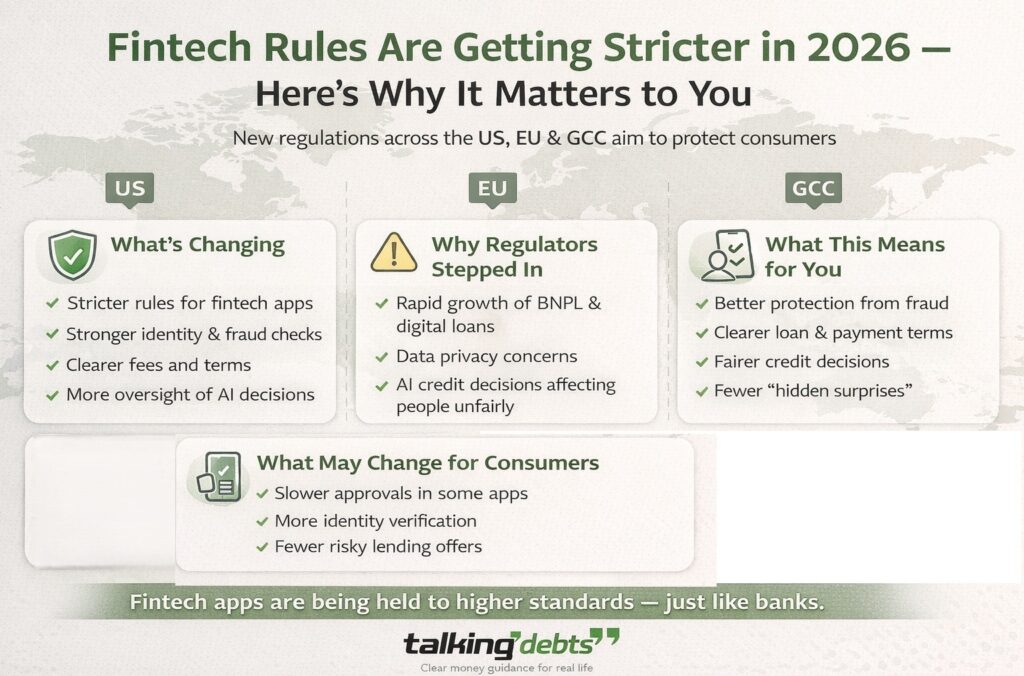
Regulators point to a convergence of risks that accelerated through 2024 and 2025. Explosive growth in digital payments, embedded finance, crypto-linked services, and AI-based credit underwriting has outpaced existing supervisory frameworks. Several high-profile enforcement actions—ranging from data privacy breaches to sanctions violations—highlighted systemic weaknesses in fintech governance.
In the US and EU alone, regulators flagged recurring issues such as inadequate customer due diligence, opaque algorithmic decision-making, weak third-party risk management, and insufficient capital buffers at fast-growing fintech lenders. In the GCC, rapid adoption of digital wallets and cross-border remittance platforms raised concerns around financial crime exposure and consumer vulnerability.
Rather than issuing fragmented guidance, regulators across regions are now synchronizing fintech compliance regulations to close loopholes and eliminate regulatory arbitrage.
United States: From Innovation-Friendly to Enforcement-Forward
In the United States, fintech oversight has entered a markedly more assertive phase. Agencies, including the Consumer Financial Protection Bureau, Securities and Exchange Commission, and federal banking regulators, are coordinating enforcement with greater intensity than in previous years.
Key developments in early 2026 include expanded examinations of fintech lenders and payment processors operating under bank partnership models. Regulators are scrutinizing whether fintech firms are effectively evading supervision by relying on sponsor banks while retaining operational control. Several consent orders issued in late 2025 laid the groundwork for tighter expectations around compliance, ownership, and accountability.
Data protection has become another focal point. US regulators are demanding clearer disclosures on how consumer financial data is collected, stored, monetized, and shared—particularly among fintech firms leveraging AI for underwriting or personalized financial products.
For fintech startups, the message is clear: fintech compliance regulations are no longer limited to AML checklists but extend deeply into governance, technology, and risk culture.
European Union: Harmonisation Meets Hard Enforcement
The European Union’s regulatory posture in 2026 reflects a dual strategy: harmonising fintech rules across member states while significantly strengthening enforcement.
Authorities such as the European Securities and Markets Authority and the European Banking Authority are pushing national regulators to apply consistent standards under new and existing frameworks. The focus is on eliminating discrepancies that previously allowed fintech firms to “passport” licenses from lightly regulated jurisdictions.
A central concern is operational resilience. EU regulators are requiring fintech firms to demonstrate robust business continuity planning, cyber resilience, and third-party risk controls. Firms reliant on cloud providers, API partners, or outsourced compliance functions are facing deeper scrutiny than ever before.
Another critical pillar of fintech compliance regulations in the EU is transparency in automated decision-making. Regulators now expect firms using AI-driven credit scoring or fraud detection to explain outcomes in a way consumers can understand—a requirement that is forcing many fintechs to re-engineer their technology stacks.
GCC: Rapid Growth Triggers Stronger Oversight
The GCC region has emerged as one of the fastest-growing fintech markets globally, and regulators are moving quickly to ensure that growth does not compromise financial integrity.
Regulators in the UAE, Saudi Arabia, and Bahrain have introduced enhanced licensing requirements for fintech firms offering payments, lending, digital assets, and open banking services. These measures include higher minimum capital thresholds, mandatory local compliance officers, and stricter reporting obligations.
Cross-border risk is a major driver of fintech compliance regulations in the GCC. With remittances and digital wallets playing a central role in regional economies, regulators are strengthening AML and counter-terrorism financing controls to align more closely with international standards.
Notably, GCC regulators are also emphasizing consumer protection. Disclosure requirements for fees, interest rates, and dispute resolution mechanisms are being tightened, particularly for buy-now-pay-later and short-term credit platforms that have seen rapid adoption among younger consumers.
Licensing and Capital: A Higher Bar for Market Entry
One of the most immediate impacts of tightened fintech compliance regulations is the rising cost of market entry. Across the US, EU, and GCC, regulators are raising expectations around capital adequacy, governance structures, and senior management accountability.
Fintech firms that once relied on rapid scaling and regulatory ambiguity are now being required to demonstrate long-term financial resilience. In several jurisdictions, provisional or “sandbox” licenses are being replaced with full authorisation regimes, reducing regulatory flexibility for early-stage firms.
This shift is already influencing investor behaviour. Venture capital firms are increasingly favouring fintech startups with strong compliance foundations, experienced risk leadership, and clear regulatory roadmaps. Compliance readiness is becoming a valuation driver rather than a post-funding afterthought.

AML, Sanctions, and Financial Crime Controls
Anti–money laundering and sanctions compliance sit at the heart of the 2026 regulatory tightening. Regulators have expressed frustration with fintech firms that rely excessively on automated monitoring tools without adequate human oversight.
New fintech compliance regulations emphasise ongoing customer due diligence, transaction monitoring tailored to product risk, and rapid escalation of suspicious activity. Firms offering crypto-linked services, cross-border payments, or embedded finance products are under particular scrutiny.
Regulators are also holding boards and senior executives personally accountable for compliance failures. Enforcement actions increasingly cite governance lapses rather than technical breaches alone, signalling a cultural shift in regulatory expectations.
Technology, AI, and Model Risk Management
Artificial intelligence has become both a growth engine and a regulatory flashpoint for fintech firms. In 2026, regulators are demanding that AI-driven systems be explainable, auditable, and free from discriminatory bias.
Fintech compliance regulations now extend into model risk management, requiring firms to document training data, testing methodologies, and decision logic. Black-box models that cannot be reasonably explained to regulators—or consumers—are facing heightened enforcement risk.
This has prompted many fintech firms to slow the rollout of advanced AI products or invest heavily in governance frameworks that align innovation with regulatory expectations.
Global Coordination and the End of Regulatory Arbitrage
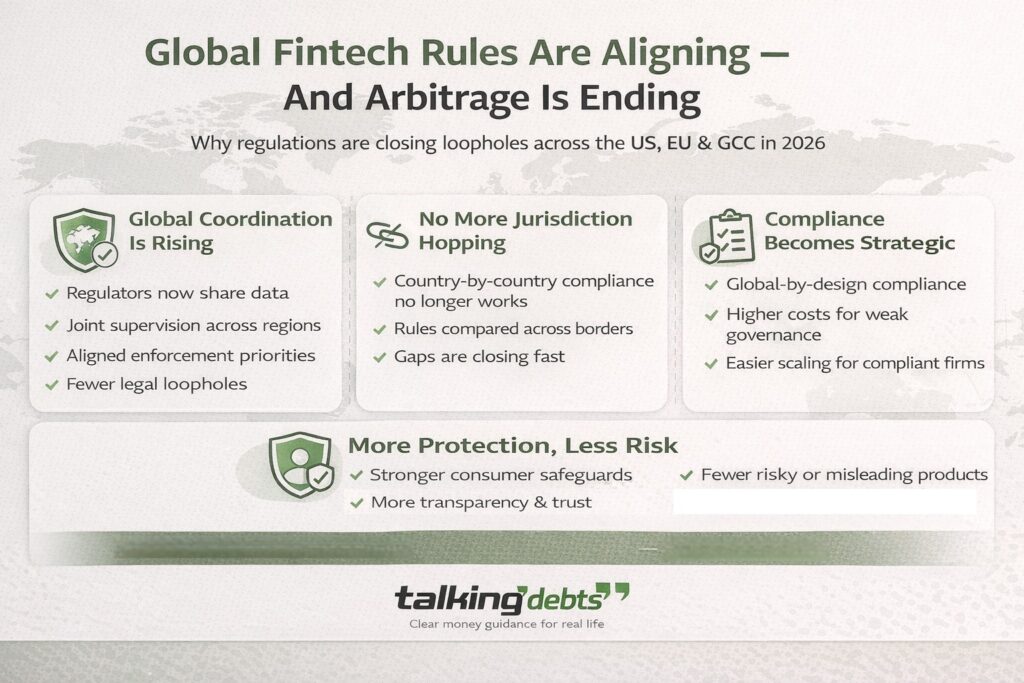
Perhaps the most significant development in early 2026 is the level of coordination among regulators. Information-sharing agreements, joint supervisory colleges, and aligned enforcement priorities are reducing opportunities for fintech firms to exploit jurisdictional gaps.
For multinational fintechs, compliance strategies must now be global by design. Fragmented, country-by-country approaches are proving costly and inefficient in an environment where regulators increasingly compare notes.
This convergence of fintech compliance regulations is reshaping how firms approach expansion, partnerships, and product launches.
What This Means for the Fintech Industry
The tightening of fintech compliance regulations is not anti-innovation—it is a recalibration. Regulators consistently state that their goal is sustainable innovation built on trust, transparency, and resilience.
For fintech firms, compliance is no longer a defensive function. It is a strategic capability that influences growth, funding, and long-term viability. Firms that invest early in strong compliance frameworks are better positioned to scale, partner with regulated institutions, and weather regulatory scrutiny.
Conversely, fintechs that view compliance as a box-ticking exercise risk enforcement actions, reputational damage, and restricted market access.
Final Thoughts on Fintech Compliance Regulations in 2026
Early 2026 marks a turning point for the global fintech sector. As regulators across the US, EU, and GCC tighten fintech compliance regulations, the industry is entering a more mature and disciplined phase.
The message from regulators is consistent across borders: fintech innovation must be matched by robust governance, consumer protection, and financial crime controls. Firms that adapt quickly will find new opportunities in a more stable and trusted ecosystem. Those that resist will face rising regulatory, operational, and financial pressure.
In the evolving global financial landscape, compliance is no longer the cost of doing business—it is the foundation of sustainable fintech growth.


