

Global Corporate & Household Debt Hits New High — Implications for Lenders and Recovery Agencies

Global corporate and household debt has surged to a new historic peak, raising alarms across financial institutions, regulators, and debt recovery professionals worldwide. After years of ultra-low interest rates, pandemic-era stimulus, and aggressive credit expansion, the global economy is now carrying a heavier debt load than at any previous point. As borrowing costs remain elevated and growth moderates, lenders and recovery agencies are entering a decisive phase where operational resilience, data-driven risk management, and disciplined recovery strategies are no longer optional — they are essential.
The rise in debt is not confined to one region or borrower class. Corporations continue to rely on leverage to sustain operations and refinance legacy obligations, while households face mounting pressure from mortgages, credit cards, personal loans, and buy-now-pay-later products. The convergence of these trends is reshaping credit risk, collections performance, and recovery timelines across developed and emerging markets alike.

A Global Debt Buildup That Refuses To Unwind
Despite expectations that higher interest rates would force a broad deleveraging cycle, total corporate and household debt has continued to grow in nominal terms. In many economies, debt growth has merely slowed rather than reversed. Inflation has inflated balance sheets, while refinancing activity has extended debt maturities without materially reducing principal exposure.
Corporations, particularly in capital-intensive sectors such as real estate, infrastructure, manufacturing, and energy, have leaned on debt markets to bridge cash-flow gaps and fund restructuring. Many firms that borrowed aggressively during low-rate periods are now rolling over obligations at significantly higher costs, increasing vulnerability to earnings shocks.
Households face a parallel challenge. Mortgage balances remain high, especially in markets where home prices surged during the pandemic. At the same time, unsecured consumer debt has risen sharply as households have relied on credit to offset higher living costs. Credit cards, installment loans, and short-term digital credit products are increasingly used for essentials rather than discretionary spending — a key warning signal for lenders.

Higher interest rates change everything
What makes today’s debt environment uniquely risky is not just the size of outstanding obligations, but the cost of servicing them. Interest rates across major economies remain well above pre-2020 averages, fundamentally altering repayment dynamics.
For corporates, higher rates mean thinner interest coverage ratios and reduced flexibility to absorb revenue volatility. Firms that appeared solvent under low-rate assumptions are now facing refinancing stress, covenant breaches, and rating downgrades. This is particularly pronounced among mid-sized companies that lack access to diversified funding sources.
For households, rising rates translate into higher monthly payments, especially for variable-rate mortgages and revolving credit. Even modest increases in servicing costs can push vulnerable borrowers into delinquency when combined with stagnant wage growth or job insecurity.
The result is a slow but steady rise in early-stage arrears, restructurings, and payment extensions — a trend that often precedes a broader deterioration in credit quality.
What this means for banks and lenders
Lenders are operating in a more complex risk environment than headline default rates alone suggest. While systemic collapse is not imminent, pressure is building beneath the surface.
One key challenge is delayed stress recognition. Many borrowers are still meeting obligations, but only by cutting investment, drawing down savings, or refinancing repeatedly. This masks underlying fragility and increases the severity of losses when defaults eventually occur.
Provisioning strategies are also under strain. Banks must balance profitability with prudence, increasing expected credit loss buffers without unduly constraining lending. In competitive markets, tightening standards too aggressively risks losing market share, while moving too slowly exposes institutions to sudden asset-quality shocks.
Sector concentration is another growing concern. Exposure to leveraged real estate developers, highly indebted SMEs, or consumer portfolios heavy in unsecured credit can amplify losses during downturns. As a result, lenders are increasingly relying on granular borrower data, real-time monitoring, and predictive analytics to identify risk pockets earlier.
Operationally, this environment demands closer coordination between origination, risk, legal, and recovery teams. The traditional handoff from lending to collections after delinquency is no longer sufficient. Early intervention, restructuring options, and pre-default engagement are becoming core components of credit risk management.
A changing landscape for recovery agencies
For debt recovery and collection agencies, the global debt surge is reshaping both opportunity and responsibility. Higher debt levels naturally expand the recoverable universe, but the nature of recoveries is evolving rapidly.
Simple, high-volume collections models are losing effectiveness as cases become more complex, legally sensitive, and cross-border. Corporate recoveries increasingly involve layered capital structures, multiple creditors, and negotiated outcomes rather than straightforward enforcement.
Household recoveries, meanwhile, face heightened regulatory scrutiny. Consumer protection standards are tightening, particularly around vulnerable borrowers, digital outreach practices, and transparency in repayment arrangements. Agencies that fail to adapt risk penalties, reputational damage, and loss of lender trust.
Recovery timelines are also extending. Court backlogs, insolvency proceedings, and restructuring negotiations can delay outcomes, affecting cash flows for both agencies and creditors. This places a premium on operational efficiency, accurate case prioritization, and realistic recovery forecasting.
The growing role of data and technology
In this high-debt environment, data quality and analytical capability are decisive differentiators. Lenders and recovery agencies alike are investing in tools that move beyond reactive collections toward predictive recovery management.
Advanced segmentation allows portfolios to be triaged based on probability of cure, optimal contact strategy, and expected recovery value. Machine-learning models help identify borrowers who are temporarily distressed versus structurally insolvent, enabling tailored engagement strategies.
Automation is also transforming operations. Digital outreach, self-service repayment portals, and AI-assisted agent workflows reduce costs while improving borrower experience. For agencies operating across jurisdictions, centralized data platforms improve compliance monitoring and reporting consistency.
However, technology alone is not enough. Successful recovery strategies combine analytics with experienced human judgment, legal expertise, and ethical engagement practices. In an environment where public trust in financial institutions is fragile, how debt is recovered matters almost as much as how much is recovered.
Regulatory pressure and conduct risk
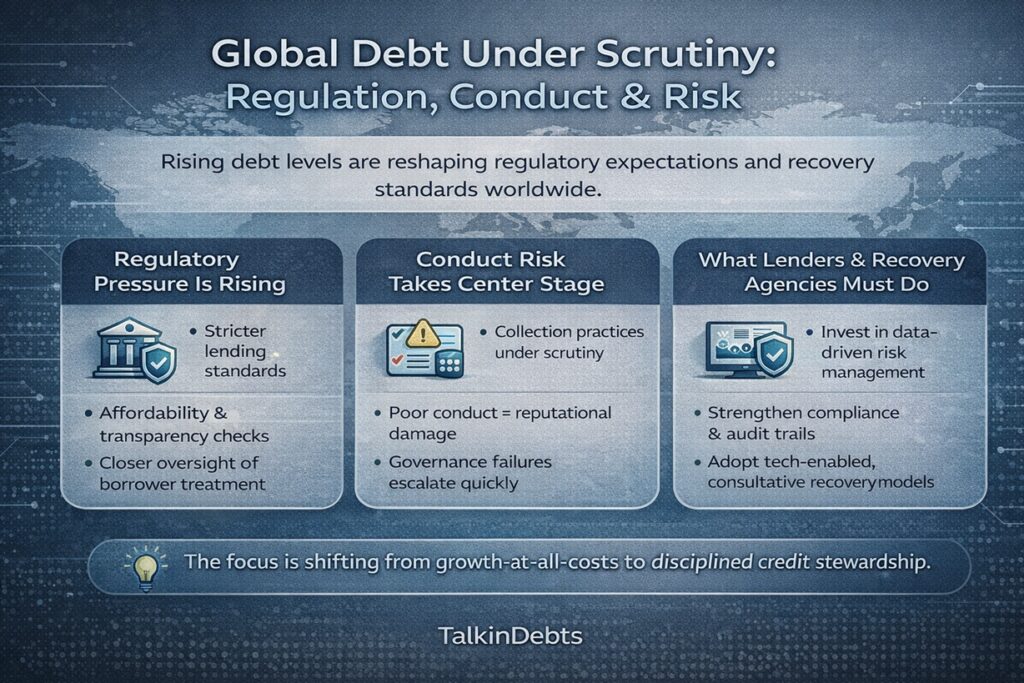
Rising debt levels have drawn the attention of regulators concerned about financial stability and social impact. Authorities are closely monitoring lending standards, collection practices, and the treatment of distressed borrowers.
For lenders, this means heightened expectations around affordability assessments, transparency, and fair treatment throughout the credit lifecycle. For recovery agencies, compliance frameworks must be robust, auditable, and aligned with evolving standards.
Missteps in collections conduct can quickly escalate into systemic reputational risk for creditors. As a result, lenders are becoming more selective about recovery partners, favoring agencies with strong governance, technology-enabled controls, and proven compliance records.
Preparing for the next phase of the debt cycle
The global debt buildup is not an abstract macroeconomic statistic — it is an operational reality that will shape credit markets for years to come. While a sharp global deleveraging has not yet materialized, the conditions for increased stress are firmly in place.
Lenders that invest early in data-driven risk management, proactive borrower engagement, and integrated recovery strategies will be better positioned to absorb shocks. Recovery agencies that evolve toward consultative, technology-enabled, and compliant models will remain essential partners in preserving asset value.
Ultimately, the new high in corporate and household debt marks a turning point. The focus is shifting from growth-at-all-costs lending to disciplined credit stewardship. In this environment, effective recovery is not just about collections — it is about maintaining stability, protecting consumers, and sustaining trust across the financial system.


