European and North American Lenders Monitor Middle East Crisis for Debt Market Spillovers
Rising geopolitical tensions trigger fresh scrutiny of cross-border exposure, emerging market debt stability, and global lending strategies.
April 2026 —
Escalating tensions in the Middle East are once again placing global financial systems on high alert, as European and North American lenders intensify their monitoring of potential spillover effects across international debt markets. With geopolitical uncertainty deepening, banks, institutional investors, and credit funds are reassessing their exposure to volatile regions, particularly in emerging markets that are historically sensitive to external shocks.
The growing concern is not limited to direct lending in the Middle East. Instead, it reflects a broader fear that instability in the region could ripple through interconnected global debt markets, affecting sovereign bonds, corporate credit, and cross-border financing flows.
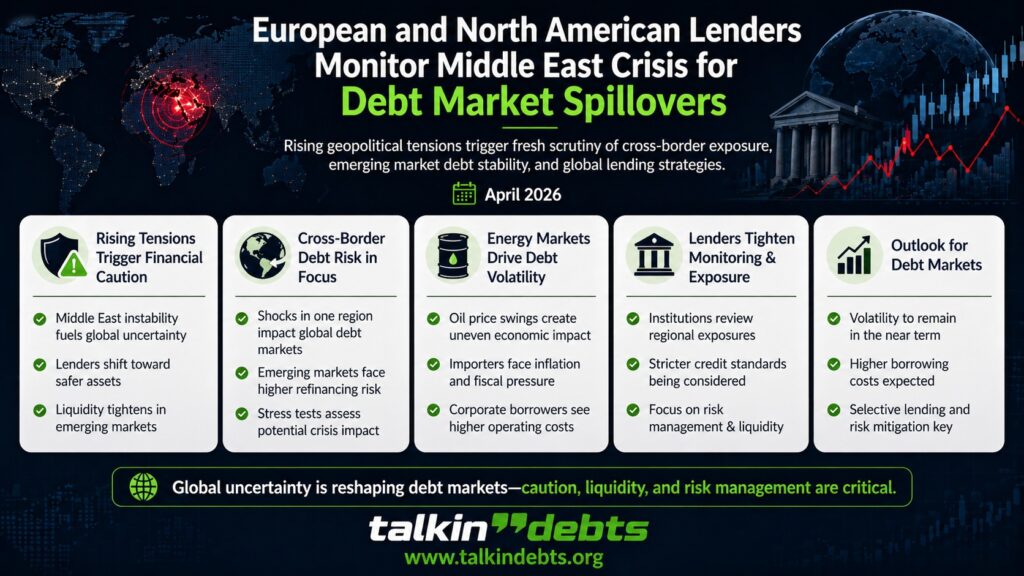
Rising Tensions Trigger Financial Caution
The Middle East has long been a critical node in global economic stability, largely due to its influence over energy markets. However, beyond oil prices and supply disruptions, the current crisis is raising alarms within financial institutions that maintain diversified international lending portfolios.
European banks, many of which have significant exposure to emerging markets across Africa, Asia, and Eastern Europe, are particularly cautious. Similarly, North American lenders—including large commercial banks, hedge funds, and private credit firms—are closely analyzing potential vulnerabilities in their debt holdings.
Market analysts note that geopolitical conflicts often act as catalysts for broader financial tightening. When uncertainty rises, lenders typically shift toward safer assets, reducing exposure to higher-risk regions. This behavior can trigger liquidity constraints in emerging markets, leading to increased borrowing costs and refinancing challenges.
Cross-Border Debt Risk in Focus
One of the primary concerns is cross-border debt risk—the potential for financial distress in one region to impact lenders and borrowers globally. In today’s interconnected financial system, debt markets are deeply integrated, meaning shocks rarely remain isolated.
Emerging market economies, many of which rely on external borrowing from European and North American institutions, are particularly vulnerable. A sudden withdrawal of capital or tightening of credit conditions can strain government budgets and corporate balance sheets.
Recent data indicates that several emerging economies already face elevated debt levels following years of pandemic-related borrowing and economic recovery efforts. The added pressure from geopolitical instability could exacerbate these vulnerabilities.
Financial institutions are now conducting stress tests to evaluate how their portfolios would perform under various crisis scenarios. These assessments include potential currency depreciation, rising interest rates, and increased default risks in affected regions.
Energy Markets and Debt Volatility
The Middle East crisis is also influencing global energy markets, which in turn affects debt dynamics. Rising oil prices can have mixed effects: while energy-exporting nations may benefit from increased revenues, energy-importing countries often face higher inflation and fiscal pressure.
This divergence creates uneven risk profiles across different regions. For lenders, this means a more complex assessment of creditworthiness, as traditional indicators may not fully capture the evolving economic landscape.
Higher energy costs can also impact corporate borrowers, particularly in industries heavily reliant on fuel and transportation. Companies facing increased operating expenses may struggle to meet debt obligations, raising concerns about potential defaults.
Institutional Lenders Rebalance Portfolios
In response to the growing uncertainty, institutional lenders are actively rebalancing their portfolios. This includes reducing exposure to high-risk markets, increasing allocations to safer assets such as government bonds in stable economies, and tightening lending standards.
Private credit funds, which have played an increasingly significant role in global lending, are also adjusting their strategies. Many are becoming more selective in deal-making, focusing on borrowers with strong fundamentals and resilient business models.
At the same time, some opportunistic investors are viewing the الأزمة as a chance to capitalize on distressed assets. Historically, periods of market dislocation have created opportunities for high-risk, high-reward investments. However, such strategies come with significant uncertainty and require careful risk management.
Sovereign Debt Pressures Intensify
Sovereign debt markets are particularly sensitive to geopolitical developments. Countries with high external debt levels and limited fiscal flexibility are at greater risk of facing refinancing challenges.
Several emerging economies are already grappling with elevated debt servicing costs due to higher global interest rates. The added uncertainty from the Middle East crisis could further complicate their ability to access international capital markets.
Credit rating agencies are closely monitoring the situation, with potential downgrades looming for countries deemed highly exposed to external shocks. Such downgrades can trigger a cascade of effects, including higher borrowing costs and reduced investor confidence.
Banking Sector Preparedness
Despite the rising concerns, many European and North American banks are entering this period of uncertainty from a position of relative strength. Regulatory reforms implemented after the global financial crisis have improved capital buffers and risk management frameworks.
Banks are now better equipped to absorb shocks, with enhanced stress-testing capabilities and more stringent lending practices. However, this does not eliminate the risks entirely.
Industry experts emphasize that while individual institutions may be resilient, systemic risks can still emerge if multiple regions experience simultaneous financial stress. The interconnected nature of global finance means that localized issues can quickly escalate into broader market disruptions.
Impact on Global Debt Market Outlook
The broader outlook for global debt markets is becoming increasingly uncertain. Investors are grappling with a complex mix of factors, including geopolitical tensions, inflationary pressures, and evolving monetary policies.
Central banks in both Europe and North America are closely watching the situation, as any significant disruption could influence interest rate decisions. A prolonged crisis may lead to tighter financial conditions, further impacting borrowing costs worldwide.
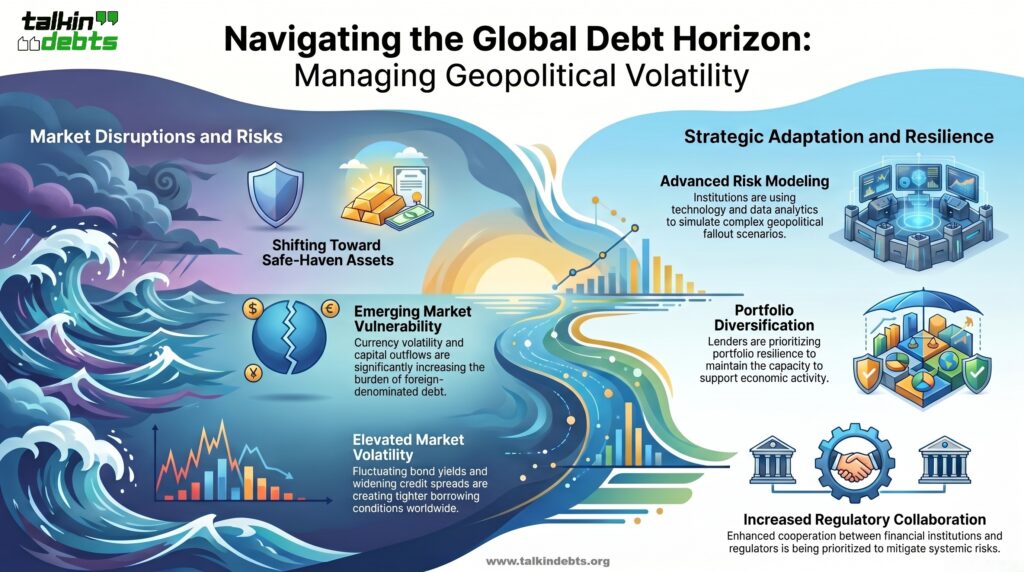
At the same time, market volatility is expected to remain elevated. Bond yields may fluctuate as investors react to changing risk perceptions, while credit spreads could widen for higher-risk borrowers.
Emerging Markets Face Renewed Challenges
For emerging markets, the current الأزمة represents a significant test of resilience. Many countries have made progress in strengthening their economic fundamentals in recent years, but vulnerabilities remain.
Currency volatility is a key concern, as capital outflows can lead to depreciation, increasing the burden of foreign-denominated debt. Additionally, reduced access to international financing can limit governments’ ability to implement economic support measures.
International financial institutions may play a crucial role in providing الدعم to affected economies. However, the scale and سرعة of any assistance will be critical in preventing broader financial instability.
Investor Sentiment Turns Cautious
Investor sentiment has shifted noticeably in recent weeks, with a growing preference for safe-haven assets. Government bonds from stable economies, gold, and other low-risk investments are seeing increased demand.
This shift reflects a broader trend of risk aversion, which can have significant implications for global debt markets. Reduced appetite for riskier assets can lead to tighter credit conditions, particularly for borrowers in emerging markets.
Market participants are also paying close attention to developments on the ground in the Middle East, as any escalation or de-escalation could quickly influence financial conditions.
Strategic Adjustments Across the Financial Sector
The الأزمة is prompting strategic adjustments across the financial sector. Banks are revisiting their risk models, investors are diversifying portfolios, and policymakers are preparing for potential economic fallout.
Technology and data analytics are playing an increasingly important role in these efforts. Advanced modeling tools allow institutions to analyze complex scenarios and make more informed decisions in rapidly changing environments.
Collaboration between financial institutions and regulators is also expected to increase, as stakeholders work together to mitigate risks and maintain market stability.
What Lies Ahead for Global Lending
Looking ahead, the trajectory of the Middle East crisis will be a key determinant of global debt market conditions. A prolonged conflict could lead to sustained volatility and tighter financial conditions, while a resolution may restore confidence and stabilize markets.
For now, European and North American lenders remain in a cautious stance, prioritizing risk management and portfolio resilience. The emphasis is on navigating uncertainty while maintaining the capacity to support economic activity.
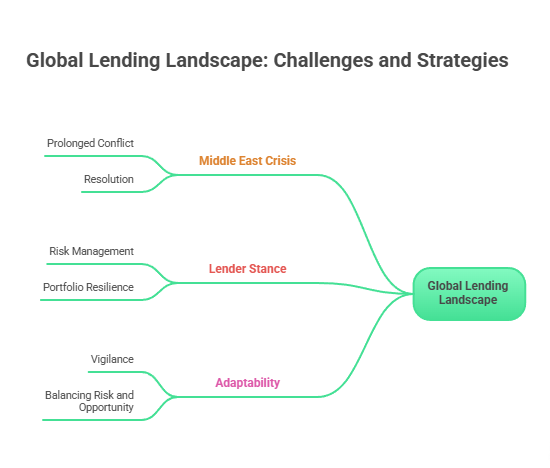
The situation underscores the importance of adaptability in today’s financial landscape. As geopolitical and economic factors continue to evolve, lenders and investors must remain vigilant, balancing risk and opportunity in an increasingly complex global environment.